ChatGPT Ads 2026: Cost, Targeting, First Test

ChatGPT ads are no longer news. OpenAI opened a self-serve Ads Manager to US advertisers on May 5, 2026, with no minimum spend. Four months on, the channel has gone international and crossed a $1 billion annualized revenue run rate. The question has changed. It is no longer "is this real?" It is "how do I run this without burning budget?"
That is the gap this guide fills. You get the state of play as of September 2026, the creative limits you must write inside, a first-test structure you can copy, and an honest list of what the platform still cannot do. I will also flag where the hype runs ahead of the product.
What changed between May and September 2026?
ChatGPT ads went global and the campaign tools matured. The measurement gaps that worried buyers in May are still open in September. More markets, more controls, same attribution problem.
The US pilot began on February 9, 2026. Early reports put the first spend minimum near $200,000, with CPM-only buying. By April the floor had dropped to $50,000. On May 5 it hit zero for US businesses.
Then the map widened. By mid-2026 the product had reached the United Kingdom, Canada, Australia, New Zealand, Mexico, Brazil, Japan and South Korea, as Digiday reported. Japan and South Korea mattered most for anyone chasing high-value clicks. Together with Mexico and Brazil, they pushed the product into markets where the main user language is not English, so localized copy stopped being optional. In August 2026, ChatGPT ads expanded to 31 European markets. That covers the 27 EU states plus Iceland, Liechtenstein, Norway and Switzerland, per Search Engine Roundtable. Self-serve access for European advertisers followed by early September, alongside Ads Manager access across India, the Middle East and North Africa. OpenAI's stated ad revenue target for 2026 is $2.5 billion, so this is not a pilot any more.
Where do the ads appear, and who sees them?
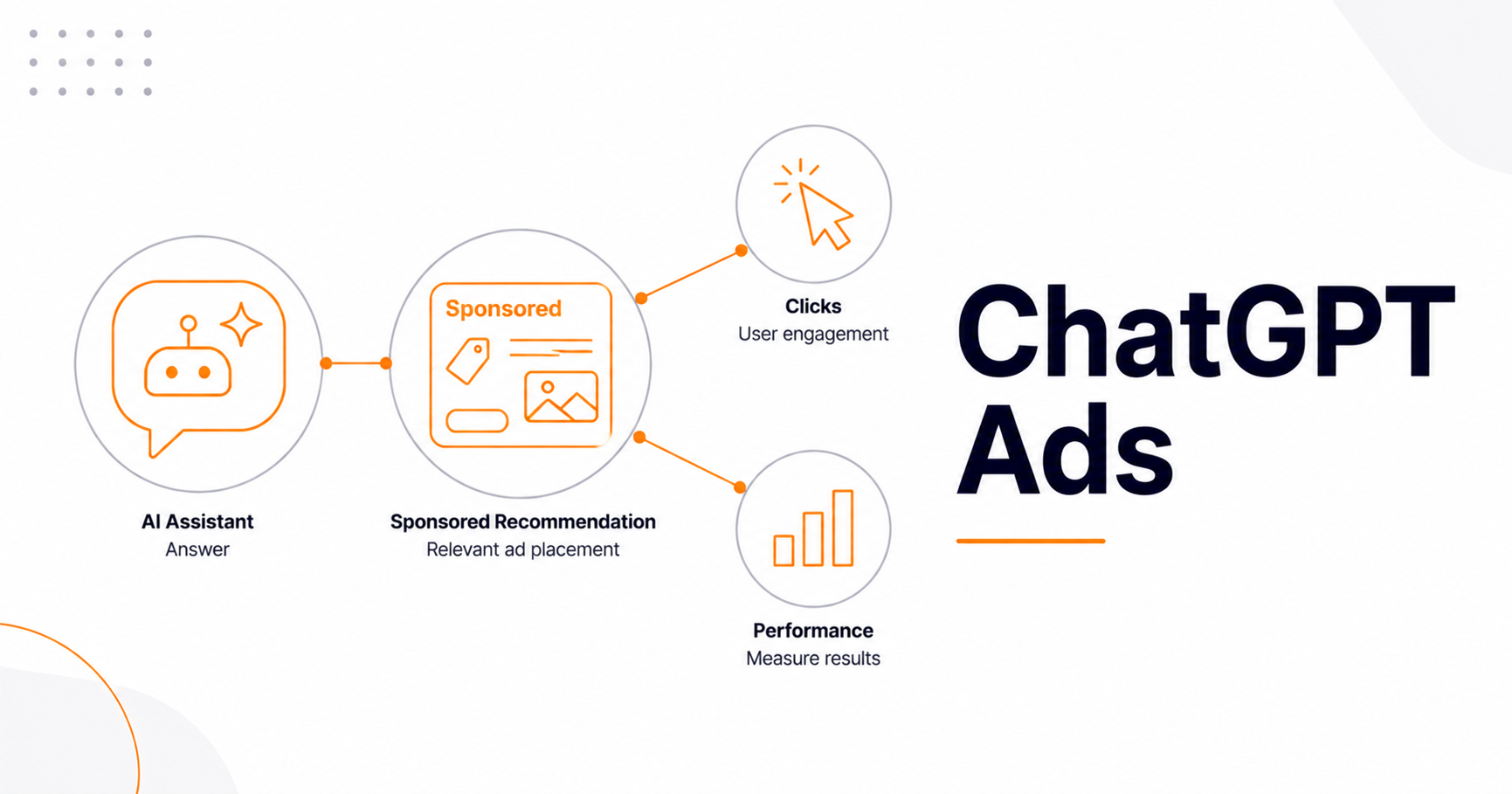
Ads appear as clearly labeled sponsored cards after the answer, visually separate from it. Only Free and Go users in eligible regions see them. Plus, Pro, Business and Enterprise accounts stay ad-free.
That placement rule is the whole product. OpenAI is firm that ads do not shape the model's response. The firewall is not a nicety. If users ever believe ads bend the answers, trust collapses and the channel dies with it. You are buying a card beside the answer, not a mention inside it.
The tier split also defines your audience. You reach the free tier, which skews broad and top of funnel. That suits discovery offers. It is a poor match if your buyer is a paying power user.
What does the ad format allow, and how do you write for it?
The self-serve unit is a compact card. You get a title of roughly 3 to 50 characters, about 100 characters of body copy, an image, a favicon and a target URL. That is very little room.
OpenAI has added reporting views and more campaign controls since launch, including an account overview and some audience options. The creative unit has stayed tight. Video and carousel are not part of the self-serve set. Treat the constraint as a feature. It forces one clear promise per card.
Here are two illustrative pairs I built to show the difference. They are constructed examples, not campaign results.
- Weak title: "Best Project Management Software 2026". Better title: "Gantt charts for 5-person teams".
- Weak body: "Powerful, flexible and easy to use for teams of all sizes." Better body: "Free for 5 users. No card. Import from Trello in one click."
The better versions win because they name a person and a job. Vague superlatives waste your 100 characters. Count every character before you upload, which our Word Counter makes trivial. The card also shows your favicon. Our favicon generator turns an image into one in about two minutes, and it is worth eyeballing the result at 16 by 16 pixels before you launch.
How does intent targeting differ from keywords?
Targeting is contextual. The system matches your ad to the topic of the current conversation, not to a cookie, a profile or a retargeting list. You describe your intent in an open text box.
Those descriptions are usually called hints. They are not match types. In Google Ads you bid on a query string and control how loosely it matches. Here you describe a situation. Insights come back aggregated, and you never see private conversations or individual user data.
The trade-off is real. You lose lookalikes, granular audience layering and true retargeting. You gain a signal that keywords rarely capture, which is where the person sits in their decision. If you have not mapped that, our post on search intent and micro-intents is the right prep work.
How should you write hints instead of keywords?
Write the situation your buyer is in, in the words they would use with an assistant, then narrow it until it excludes your bad-fit traffic. Think sentences, not phrases.
A keyword list says "running shoes". A hint says "someone comparing cushioned road running shoes for a first marathon". The second carries constraints. Constraints are what stop you paying for browsers.
Three habits help. Name the exclusion out loud, like "not for trail running". Describe the stage, like "already shortlisted two options". Keep one hint per ad group so you can read the results. Mixed hints produce averages you cannot act on.
What does a bid buy, and how does the auction pick winners?
You bid CPC or CPM, and the auction is relevance-weighted. A well-matched ad on a smaller bid can beat a loose ad with a bigger one. Relevance is your leverage.
CPC is the performance-aligned option. OpenAI's recommended starting maximum bid has been around $3 to $5 per click, and very low bids struggle to deliver. CPM buying still exists and has come down since the pilot. I will not quote a current CPM figure, because it has moved more than once this year. Check the rates in your account, not in a blog post.
The takeaway is simple. Spend week one improving relevance, not raising bids. A tighter hint and a sharper card usually beat a 30 percent bid increase.
How do you structure a first test?
Budget a fixed learning amount, run one offer against three hints for at least two weeks, and decide in advance what result makes you stop. Write the stop rule down first.
Treat your first ChatGPT ads test as tuition. A learning budget buys three things: a click-price range for your category, a read on which hints deliver volume, and a landing page benchmark. It does not buy a reliable cost per acquisition. Not yet.
Here is the shape I would use. Pick one offer with a clear yes or no action. Build three ad groups, one hint each, two cards per group. Cap daily spend at a number you would not have to defend in a meeting. Run two full weeks so day-of-week effects wash out.
Then judge it on three questions. Did clicks arrive at a sane price? Did those visitors behave like people with intent? Did anything convert at all? Two yeses out of three is enough to continue. One yes means fix the landing page first.
How do ChatGPT ads compare with Google and Meta ads?
Google captures stated demand, Meta interrupts attention, and the assistant reaches people mid-decision. These are not substitutes. They sit at different points in one journey.
| Dimension | Ads in ChatGPT | Google Search Ads | Meta ads |
|---|---|---|---|
| Targeting basis | Conversation topic. | Query and match type. | Profile and lookalike. |
| Creative | One small card. | Text, assets, extensions. | Image, video, carousel. |
| User mindset | Researching or deciding. | Actively searching. | Browsing, not shopping. |
| Measurement | Young. Pixel and API. | Mature. | Mature. |
| Best fit | Considered purchases. | Known demand. | Demand creation. |
Read that as a planning aid, not a ranking. If you already win on Google, the assistant is where you defend that win as behaviour shifts. Our explainer on Google AI Mode covers the same shift on Google's own surface.
What does your landing page need to do?
An AI-referred visitor arrives mid-decision. The page must confirm the exact claim in your card within one screen, then offer one action. No warm-up. No brand story.
This visitor has already been briefed by an assistant. They know the category and have seen alternatives. They want proof that you match the description they just read. If your card promised "free for 5 users", that phrase belongs above the fold in the same words.
Three things I would fix before spending a euro or a dollar. Load speed, because impatience is high on a paid click, and our Core Web Vitals guide covers the thresholds. Mobile layout, since much of this is phone traffic, which our mobile SEO guide addresses. And image weight, the usual culprit behind slow pages. See our notes on optimizing images for the web, then run a quick on-page checklist pass.
What should you measure while attribution is young?
Measure what you control: click quality, on-page behaviour, assisted conversions and a clean holdout. Platform-reported cost per acquisition cannot settle an argument yet.
OpenAI shipped a conversion pixel and a Conversions API, so post-click tracking works. Landing views, sign-ups, add-to-cart and purchases can all fire. That is a real step. The wider stack is thinner. Agency buyers interviewed by AdExchanger in September 2026 called the conversion tracking and audience options limited, and asked for benchmarks and third-party integrations. Separately, Criteo's own reporting on its ChatGPT ads integration has found that AI-referred visits convert better than average, which fits the mid-decision mindset.
So build your own read. Tag every destination URL with clean UTMs and keep them consistent. Watch assisted paths, not just last click. Our walkthrough on tracking AI referral traffic in GA4 shows the custom channel group and regex to build.
For a holdout, geography is the cleanest lever most teams have. Pick two comparable regions with similar baseline demand. Run ads in one and not the other. Hold everything else steady for four weeks, including email and organic pushes. Then compare total conversions, not channel-reported ones. It is blunt, and it is far more honest than a young attribution model.
Why is a paid card not the same as an organic citation?
A sponsored card sits beside the answer. A citation sits inside it. Money buys the first and cannot buy the second. That is the strategic point for anyone doing SEO.
ChatGPT ads buy attention next to a recommendation. Being the recommendation is earned. It comes from clear, well-structured, genuinely useful content that assistants can quote. Our playbook on getting cited by ChatGPT, Perplexity and Gemini is the practical version of that work.
The best posture is both at once. Buy the card while the competition is still thin. Keep earning the mention. For the framework, start with answer engine optimization, then our generative engine optimization guide. If the acronyms blur, we untangle them in AEO versus GEO versus SEO. Trust signals decide who gets quoted, which our E-E-A-T guide covers. Publishers testing machine-readable summaries should also read our take on llms.txt.
What do European advertisers need to know?
ChatGPT ads now serve across the EEA and Switzerland, and self-serve buying for European advertisers opened days later. The privacy posture differs from the US.
Reporting on the European rollout describes contextual signals such as conversation topic, approximate location, device type, time of day and language. Coverage also points to a more conservative consent approach in Europe than in the US, with opt-in for personalized advertising. Treat the specifics as live. Check the current terms in your own account before launch, because this is exactly the area regulators revisit.
Two practical notes. Some regulated categories have been restricted outside the US, so confirm eligibility before you build creative. And your GDPR obligations do not move just because the ad platform is new. Consent, data transfers and your own pixel behaviour remain yours to defend. If you run multi-market campaigns, Japan and South Korea are live too, so budget for localized copy.
Which mistakes cost the most money?
The expensive errors are strategic, not technical. These are the five I would guard against hardest.
- Running broad hints and calling the result a channel verdict. One vague hint tests nothing.
- Sending clicks to a homepage. The visitor arrived mid-decision and a homepage restarts them.
- Judging week one on cost per acquisition. The attribution cannot carry that decision.
- Writing brand copy in a 50-character title. Say the offer, not the mission.
- Pausing everything after a bad Tuesday. Small budgets produce noisy days by design.
There is a sixth that is less obvious. Teams move budget out of organic AI visibility to fund the ad test. That is a bad trade, because the organic mention outlives the campaign. Our zero-click search guide explains why visibility inside answers compounds even when nobody clicks.
Who should skip this for now?
Sit this out if you need mature attribution, granular audience control or very large scale this quarter. The platform cannot give you those yet.
Skip it if your product needs a demo, because a card and one page will not carry that. Skip it if your margins only work with tight cost control. Skip it if your category is restricted in your market. And skip it if your landing pages are slow, since you would pay to send people to a poor experience.
My read is that most small and mid-sized advertisers with a simple offer should run a small test. Most enterprise teams with strict measurement rules should wait a quarter and watch.
Frequently asked questions
How much do ChatGPT ads cost?
There is no minimum spend for self-serve buying. You bid by CPC or CPM. OpenAI's recommended starting maximum bid has been around $3 to $5 per click, and very low bids tend to under-deliver. CPM pricing has moved several times since the February 2026 pilot, so check current rates in your account rather than trusting an article. The auction weights relevance, so a sharper card can win at a lower bid.
Do ChatGPT ads change the AI's answer?
No. Ads appear as clearly labeled sponsored cards that sit visually apart from the response, and OpenAI states they do not influence what the model says. That separation is deliberate and commercially essential. If users came to believe answers were for sale, the trust that makes the assistant useful would erode and the ad business would lose its audience. Buying ads cannot make the assistant recommend you.
Who sees ads inside ChatGPT?
Ads are shown to users on the Free and Go tiers in eligible regions. Plus, Pro, Business and Enterprise accounts do not see them. So you reach a broad, largely top-of-funnel audience rather than paying power users. Plan the offer accordingly. Free trials, entry-level products and clear discovery offers fit this audience far better than complex enterprise propositions that need a sales conversation.
Can European businesses buy ads in ChatGPT?
Yes. Serving expanded to 31 European markets in August 2026, covering the EU plus Iceland, Liechtenstein, Norway and Switzerland, and self-serve access for advertisers there opened shortly after. Some regulated categories have been restricted outside the US, so verify eligibility before building creative. Consent handling in Europe is more conservative than in the US, and your own GDPR duties still apply to your pixel and your landing pages.
Do ads replace SEO or AI visibility work?
No, they complement it. Ads buy a sponsored placement beside the answer. They cannot buy a mention inside the answer, which is still earned through clear, credible, well-structured content. The strongest position runs both. Use paid to test messages and capture demand now, and keep investing in the organic work that gets you quoted, because that visibility keeps working after the budget stops.
What creative formats can I run?
The self-serve unit is a single compact card. It carries a title of roughly 3 to 50 characters, about 100 characters of body copy, an image, your favicon and a destination URL. Video, carousel and interactive formats are not in the self-serve set. Write one clear promise per card and name a specific person or job. Vague superlatives waste the little space you have and rarely earn a click.
How do I target the right conversations?
You describe your intent in an open text box rather than picking match types or audience checkboxes. Write the situation your buyer is in, in natural language, then narrow it until it excludes poor-fit traffic. Name exclusions explicitly and describe the decision stage. Keep one description per ad group so results stay readable. Expect to iterate, because published guidance on writing these descriptions is still thin.
How do I track conversions?
OpenAI provides a conversion pixel and a Conversions API, so you can record landing views, sign-ups, add-to-cart events and purchases after a click. Layer your own measurement on top. Use consistent UTM tags, watch assisted paths rather than last click alone, and run a geographic holdout where you can. Platform-reported cost per acquisition is not yet stable enough to settle a budget argument by itself.
What budget should a first test have?
Set a fixed learning budget you can lose without argument, and run it at least two full weeks so weekday patterns even out. That spend should buy a click-price range for your category, a read on which conversation descriptions deliver volume, and a landing page benchmark. It will not buy a reliable cost per acquisition. Decide your stop rule before you launch, then honour it.
Is it too late to gain a first-mover advantage?
Not entirely, though the easiest window has closed. Tens of thousands of advertisers now buy ChatGPT ads and revenue has passed a $1 billion annualized run rate, so competition is real. What stays scarce is skill. Very few teams have genuine reps at writing conversation-level targeting and tiny cards. That craft advantage is still available, and it compounds faster than a bid advantage.
Final thoughts
ChatGPT ads moved from novelty to infrastructure in about seven months. The targeting is privacy-first, the bidding is performance-aligned, and the audience arrives ready to decide. The controls are narrow and the attribution is catching up. That mix is exactly what an early channel looks like.
So do the small, unglamorous version first. Pick one offer. Write three sharp conversation descriptions. Build a fast, specific landing page. Cap the spend, run two weeks, and judge it against a holdout rather than a dashboard. Keep publishing the content that earns the organic mention, because in AI search the recommendation still outranks the card beside it.
What would you test first if the budget were fixed and the measurement imperfect? That is the real question this channel asks.