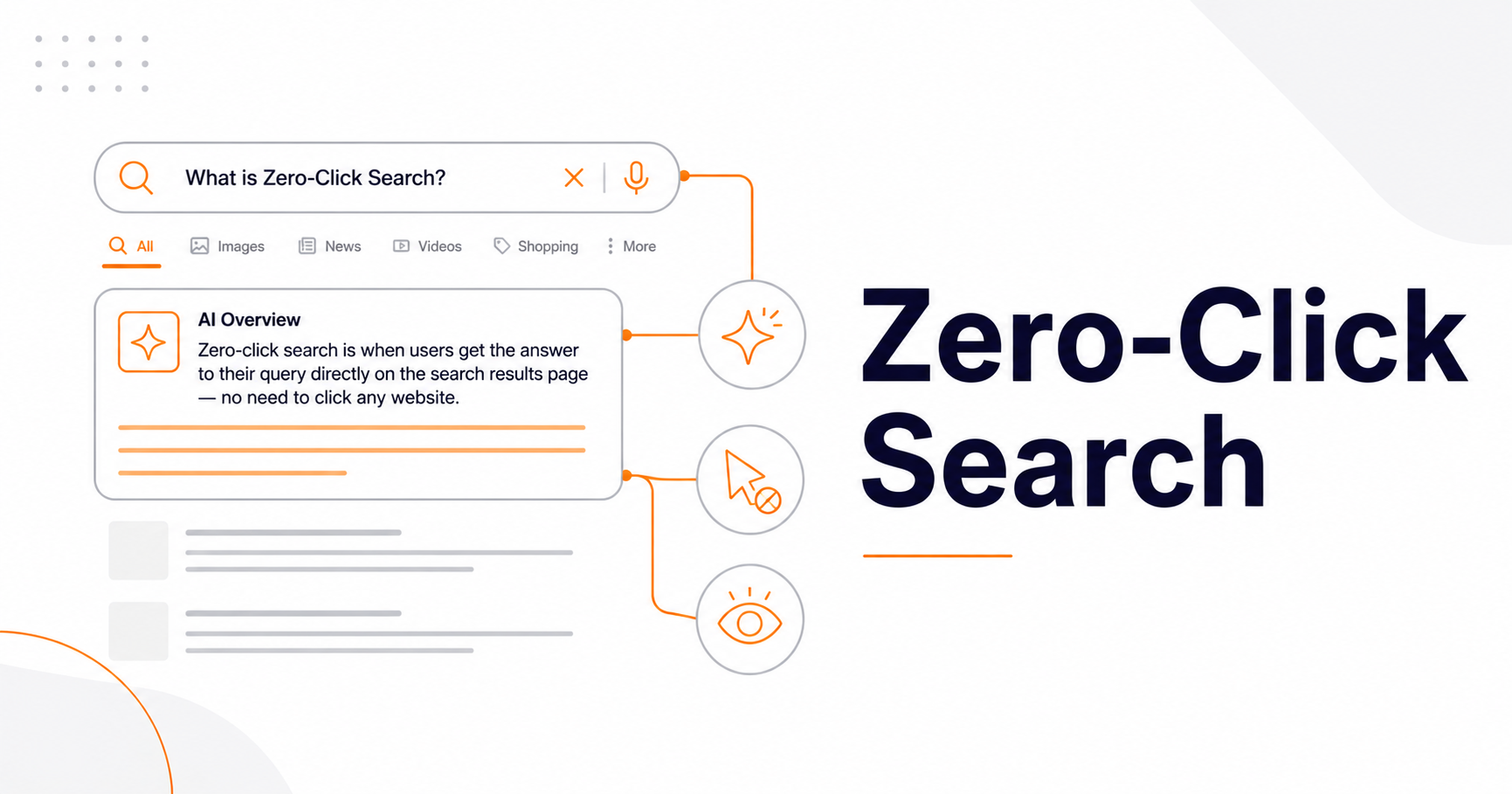
Zero-Click Search: How to Win Traffic When Nobody Clicks (2026)

A zero-click search is one where the user gets their answer directly on the results page—from an AI Overview, featured snippet, knowledge panel, or instant tool—without ever clicking through to a website. In 2026, this is no longer an edge case. Depending on which dataset you trust, somewhere around 60% of Google searches now end without a click, and the figure climbs far higher once an AI Overview is involved. The uncomfortable truth: you can rank in position one and still watch your traffic fall.
But this is not the SEO apocalypse it's often framed as. The clicks that survive are more valuable, brand visibility inside answers compounds over time, and entire categories of content remain click-rich. This guide explains what's really happening, which queries still send traffic, and exactly how to win in a search landscape where being seen matters as much as being clicked.
The numbers behind the shift
Zero-click is not new—SparkToro and Datos documented roughly 50% of searches ending without a click back in 2019, long before generative AI. What changed is the acceleration. Google's AI Overviews, rolled out globally in late 2024 and expanded aggressively since, now appear in well over half of queries—up from around 12% in 2024. When an AI Overview answers a query completely, there's simply no remaining intent that requires a visit.
The pattern is stark by query type. Searches that trigger an AI Overview show zero-click rates around 80%, versus roughly 60% for those without one. Informational "what is" and "how to" queries get summarized most effectively and lose the most traffic, while transactional, branded, and local searches still send people to websites. This is the same structural shift we unpack in our guide to ranking in AI search.
Why this isn't the disaster it looks like
Three things soften the blow, and understanding them changes your whole strategy.
First, the surviving clicks convert better. When an AI Overview appears, fewer people click—but those who do have already read the summary and are seeking depth, making them noticeably higher-intent visitors. SEO is shifting from a volume game to a quality game.
Second, citation is its own reward. According to Seer Interactive, sites cited inside an AI Overview earn roughly 35% more organic click-through than non-cited competitors on the same query. Even when no click happens, being named in the answer builds brand familiarity that later shows up as direct visits and branded searches.
Third, branded queries actually gain. Searches for your brand name that show an AI Overview tend to see CTR rise, not fall. The clearest long-term hedge against zero-click erosion is simply becoming a brand people look for by name—which loops directly back to the trust signals in our E-E-A-T guide.
The strategy: from clicks to visibility (and back)
1. Win the citation, not just the ranking
In a zero-click world the new goal is to be the source inside the answer. That means structured, extractable content: answer the question directly in the first 150–200 words, use clear question-style headings, add FAQ blocks, and include tables—AI systems parse structured data easily, which lifts your odds of selection. Lock in the formatting fundamentals from our on-page SEO checklist, and use the answer-first, scannable structure that both readers and machines reward. Keep your intros tight with help from our Word Counter.
2. Use structured data to verify credibility
Strong Organization and Author schema helps AI systems verify who you are and trust your content enough to cite it. Clean entity markup measurably increases citation frequency, so implement it deliberately—our schema markup guide walks through the JSON-LD types that matter most. Pair that with sharp titles and meta from our Meta Tag Generator so you also capture the SERP features that still drive clicks.
3. Build content that resists summarization
This is the move most sites miss. Content that can be fully summarized by AI—simple definitions, basic how-tos—suffers the worst. Content that requires interaction, fresh data, or nuanced context holds its traffic. Interactive tools and calculators are the clearest example: an AI can describe what a tool does, but it can't run it for the user. That's exactly why a library of genuinely useful, free interactive tools is one of the most durable zero-click hedges a site can build—it gives people a reason to click that a summary cannot satisfy. (Our own roundup of the 30 best SEO tools is a good illustration of click-worthy, interactive content.)
4. Target lower-AIO niches and intent
Not every query is equally exposed. Informational topics face near-total AI Overview coverage, while ecommerce, real estate, and local content see only single-digit exposure. Lean into transactional, comparison, and local queries where clicks still flow, and reserve zero-click optimization for the definitional queries where you're competing for the citation anyway.
Measure visibility, not just traffic
Old dashboards built around sessions and rankings will tell you a misleading story in 2026. Expand your reporting to include AI Overview impression share, featured snippet presence, share of voice in "People Also Ask," and—critically—branded search volume, which catches the downstream demand that AI citations create. Add a dedicated AI-citation monitoring tool alongside Google Search Console. Track your authority trend with our Domain Authority Checker and audit your key pages with the Website SEO Score Checker so you can connect content changes to visibility gains.
Common mistakes in the zero-click era
The recurring errors are simple: burying the answer beneath a long preamble, chasing high-volume informational keywords that are now fully summarized, measuring success by traffic alone while ignoring citation and brand metrics, and producing thin content that no AI would choose to quote. The site that wins is the one that answers fast, proves credibility, and gives people something a summary can't replace.
Frequently asked questions
What percentage of searches are zero-click in 2026?
Estimates vary by source and methodology, but most credible analyses put it around 60% of all Google searches ending without a click, climbing to roughly 80% or higher when an AI Overview appears. The trend has been rising steadily since about 50% in 2019, accelerated sharply by AI Overviews.
Does appearing in an AI Overview help or hurt my traffic?
On balance it helps. Being cited inside an AI Overview earns meaningfully higher click-through than not being cited on the same query, and it builds brand familiarity that drives later direct and branded searches. The catch is that the first-cited source captures most of the limited clicks, so citation position matters.
Which types of content still get clicks?
Transactional queries, branded searches, local searches, detailed comparisons, and interactive content like tools and calculators. Anything that requires a decision, an action, fresh data, or hands-on use resists being fully summarized—so it keeps sending visitors to your site.
How do I optimize for zero-click search?
Answer the question directly and early, structure content with question headings, FAQ blocks, and tables, add Organization and Author schema, build brand authority, and create interactive or nuanced content a summary can't replace. Then measure visibility metrics—citations, impressions, branded search—not just raw traffic.
Final thoughts
Zero-click search didn't take away your ranking—it took away the guarantee that ranking equals traffic. The brands thriving in 2026 stopped treating that as a crisis and started optimizing for the new reality: earn the citation, build the brand, create things a summary can't replace, and measure visibility honestly. Do that, and you don't just survive the clickless era—you compound an advantage in it.