E-E-A-T in 2026: How to Build the Authority Google & AI Actually Reward

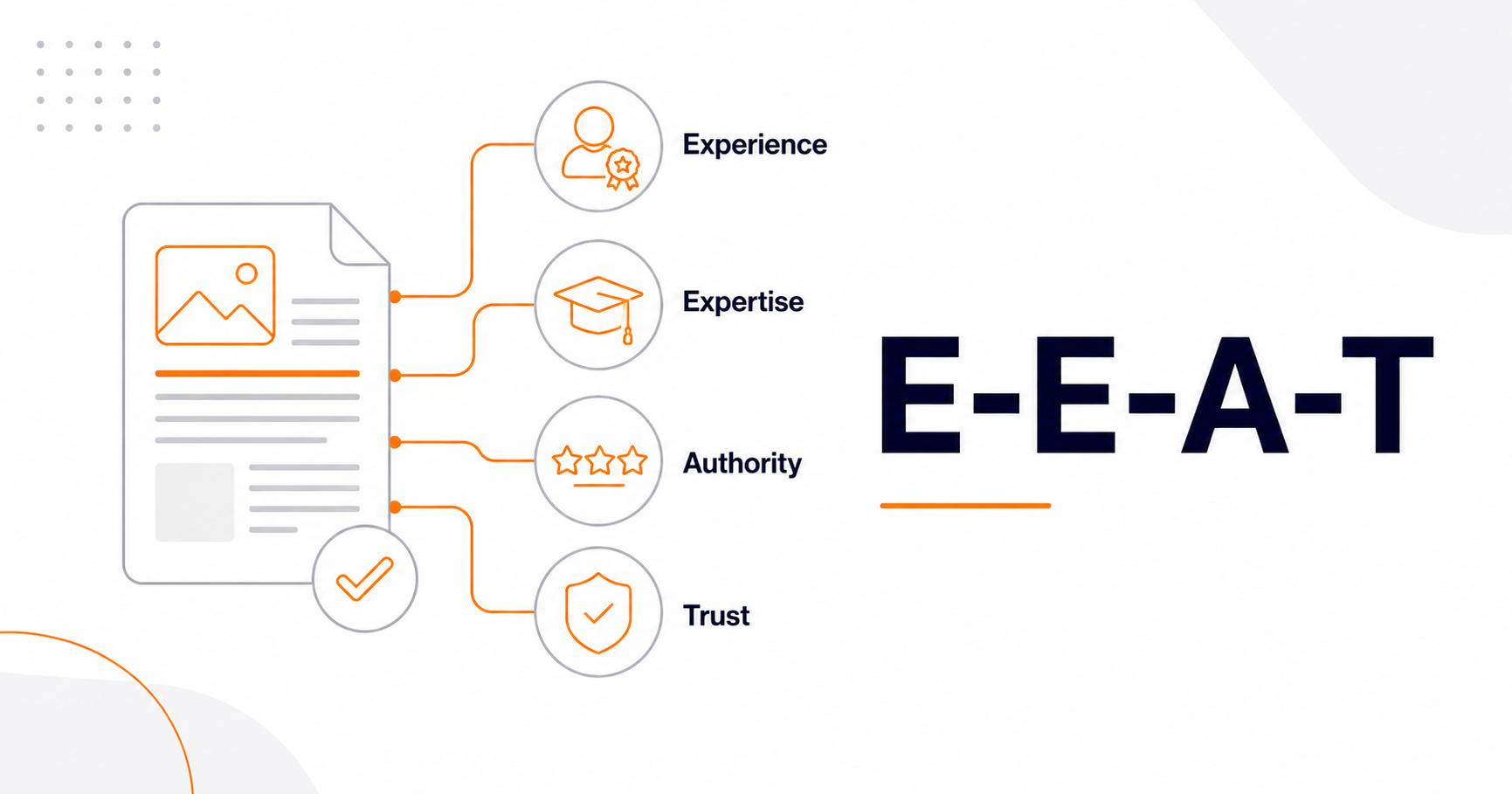
E-E-A-T stands for Experience, Expertise, Authoritativeness, and Trustworthiness—the framework Google uses to judge whether your content deserves to rank and, increasingly, whether AI engines should cite it. It is not a single button you switch on. It is a set of quality signals that tells both Google and tools like ChatGPT, Perplexity, and Gemini that real, credible people stand behind your content. In 2026, with the web flooded by fast, low-effort AI writing, that proof of credibility has shifted from "nice to have" to non-negotiable.
Here is why this matters more than it did even a year ago: the same signals Google uses to decide what to rank are the signals AI answer engines use to decide what to quote. One finding that should grab your attention—pages without a named author are roughly 40% less likely to be cited in AI answers than those attributed to a real, credentialed expert. If you want to be the source AI reaches for, E-E-A-T is where you start. This guide breaks down all four pillars and gives you a practical plan to strengthen each one.
What E-E-A-T actually is (and isn't)
The framework comes from Google's Search Quality Rater Guidelines. It began as E-A-T (Expertise, Authoritativeness, Trustworthiness) back in 2014, gained real teeth after the 2018 "Medic" update penalized sites lacking trust signals, and added the extra "E" for Experience in December 2022 to reward genuine first-hand knowledge. Important nuance: E-E-A-T is not a direct ranking factor you can measure in a dashboard. It is the rubric behind Google's core algorithm updates—the lens through which quality is judged. Content that demonstrates it consistently outperforms content that doesn't, and that logic now extends to AI Overviews, which select sources using the same core systems.
The four pillars, and how to prove each one
Experience — show you've actually done it
Experience is first-hand involvement. A dentist explaining whitening with real before-and-after guidance, or a marketer sharing the actual campaign data behind a result, demonstrates something an anonymous AI draft cannot. Build it with case studies, original screenshots, real numbers, personal anecdotes, and "here's what happened when we tried this" detail. If you lack direct experience on a topic, bring in a contributor who has it, or run original research—surveys, interviews, tests—that captures it authentically.
Expertise — demonstrate real knowledge
Expertise is depth and accuracy. Explain concepts clearly, cite credible sources and statistics, and go beyond the surface-level summary anyone could generate. This is exactly why raw AI output struggles to rank: it tends toward generic, while genuine expertise reads as specific. If you use AI to draft, layer your own knowledge on top—the workflow we describe in our guide to the best AI tools for SEO content only works when a real expert edits the output.
Authoritativeness — earn outside recognition
Authoritativeness is reputation: what other credible sources say about you, not what you say about yourself. You build it through quality backlinks, mentions on respected industry sites, consistent helpful publishing, and growing branded search demand. Unlinked brand mentions increasingly act as "implied links"—trust signals in their own right. Track how your authority trends with our Domain Authority Checker, and keep your brand entity consistent everywhere with matching social tags from the Open Graph Generator.
Trustworthiness — the one that matters most
Google has said trust is the most important member of the family—the others feed into it. Trust signals include HTTPS, clear contact details, a transparent About page, accurate and well-cited content, visible reviews and testimonials, and honest, current information. For YMYL topics—health, finance, legal, safety, major life decisions—the bar is highest, because the cost of bad information is real.
Why E-E-A-T is now an AI-visibility filter
Search engines are drowning in information pollution from low-effort content, so they need reliable ways to decide what deserves visibility and citations. When Google or an AI engine has to choose a source, it leans toward content that looks verifiably human, proven, and backed by real signals. That is why your strategy in 2026 cannot be "publish more"—it has to be "publish with proof." Strong E-E-A-T is precisely what earns the AI citations we cover in our guide to ranking in AI search, and it's your strongest hedge against the zero-click search shift that's reshaping organic traffic.
The most actionable E-E-A-T win: real author identity
If you do one thing this month, make your authors real and verifiable. Create a dedicated author profile page for every contributor with a full bio, areas of expertise, links to their published work, and external credentials. Attach a proper byline to every article. An AI engine treats "Written by a senior SEO strategist with six years of experience" very differently from no attribution at all. Reinforce this with structured data—Person and Organization schema with the sameAs property linking to verified profiles, as explained in our schema markup guide. Author identity is one of the cheapest, highest-impact moves available for both rankings and AI citations.
A practical E-E-A-T checklist for 2026
Work through these in order. Add named authors with credentialed bios and profile pages. Inject real experience—case studies, original data, screenshots, first-hand detail. Cite authoritative sources and add concrete statistics. Earn backlinks and brand mentions from respected sites in your niche. Display reviews and testimonials as social proof. Lock down trust basics: HTTPS, a clear About page, and visible contact information. Refresh older articles and add a visible "Last Updated" date. Build topical clusters so you demonstrate depth across a subject, not just one post. Every one of these pairs naturally with the page-level fundamentals in our on-page SEO checklist.
How to audit and improve your signals
Start by auditing what you have. Run your key pages through our Website SEO Score Checker to surface technical and trust gaps, then refresh stale content—our Article Rewriter helps you update dated sections quickly, and the Online Ping Website Tool nudges crawlers to re-index after you publish updates. For the wider set of platforms that help you monitor authority and backlinks, see our roundup of the 30 best SEO tools.
Frequently asked questions
Is E-E-A-T a direct ranking factor?
No. E-E-A-T is not a single ranking signal you can toggle; it is the quality rubric behind Google's core updates and human rater guidelines. It influences rankings indirectly through measurable signals—author credibility, accurate content, backlinks, reviews, and site trust—and content that demonstrates it reliably outperforms content that doesn't.
What's the difference between E-A-T and E-E-A-T?
The original 2014 framework was E-A-T: Expertise, Authoritativeness, Trustworthiness. In December 2022 Google added a second "E" for Experience, to reward first-hand, real-world involvement with a topic. The extra E specifically rewards content that proves the author has actually done the thing they're writing about.
Why does E-E-A-T matter for AI search and citations?
Because AI engines like ChatGPT, Perplexity, and Google AI Overviews lean on the same trust signals Google uses to rank pages. Content from named, credentialed experts backed by accurate data and consistent external mentions is significantly more likely to be cited than anonymous corporate content—making E-E-A-T central to AI visibility, not just rankings.
Which E-E-A-T element is most important?
Trust. Google has stated trustworthiness is the most important member of the framework, and the other three pillars ultimately feed into it. Experience, expertise, and authority all exist to support whether your content—and your brand—can be trusted, especially on sensitive YMYL topics.
Final thoughts
E-E-A-T rewards something refreshingly old-fashioned: being genuinely credible and proving it. In a web increasingly filled with anonymous AI content, real authors, real experience, real recognition, and real trust signals are what set you apart—to readers, to Google, and to the AI engines now deciding which sources to quote. Build those signals patiently and consistently, and you create a durable advantage that survives algorithm updates and the shift to AI search alike.