How to Get Cited by ChatGPT, Perplexity & Gemini in 2026

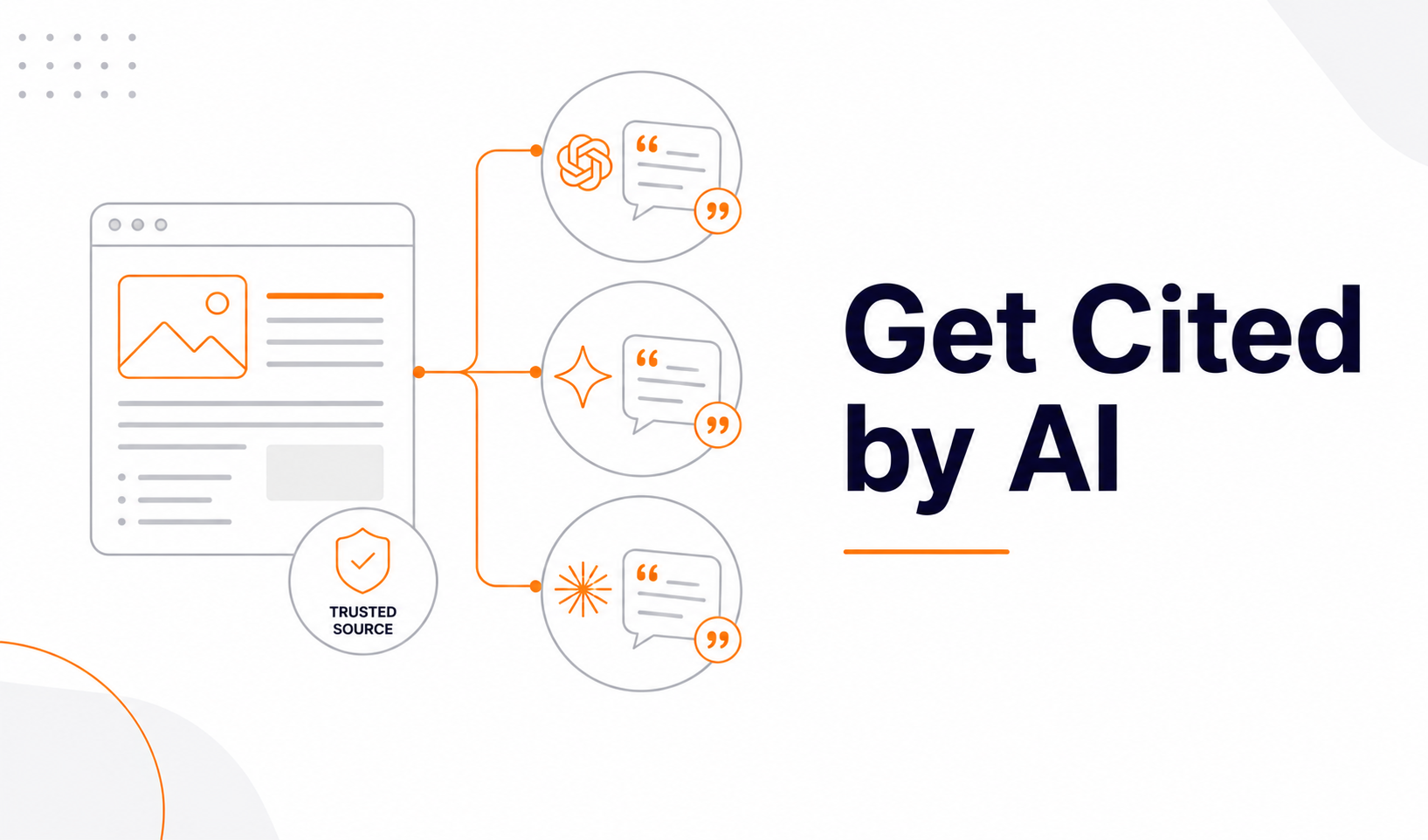
You get cited by ChatGPT, Perplexity, and Gemini in 2026 by winning retrieval: staying fully crawlable, writing passages an AI can extract and verify at the claim level, and earning enough authority that engines trust you as a source. Ranking on Google is no longer the same job as being quoted in an AI answer. When someone asks an AI engine a question, it pulls a handful of passages from across the web, synthesizes them, and credits just two to seven sources. This guide is about becoming one of them.
It matters now because the two games have measurably split apart. In mid-2025, sites ranking in Google's top ten accounted for roughly 76% of AI Overview citations; by early 2026 that share had fallen to around 38%. A strong ranking no longer guarantees you appear in the AI answer—and you can be cited without ranking first. This is the practical companion to our broader guide to ranking in AI search: less "what is GEO," more "how citations actually work and how to measure them."
Each engine picks sources differently
There is no single "AI algorithm." Three major systems, three selection logics:
ChatGPT Search leans on the Bing index. When a query needs current information, it runs a search, retrieves the top results, and cites the pages it uses as supporting documents for each sub-question. Helpfully, ChatGPT appends a utm_source=chatgpt.com tag to citation links, which makes its referrals easy to spot in your analytics.
Perplexity casts a wider net, often reviewing 20–40 URLs per query before choosing the most authoritative few. It shows a strong bias toward primary sources—original research, official documentation, and first-party data are cited several times more often than secondary summaries—and favors established industry, government, and education domains.
Gemini and Google's AI Overviews / AI Mode draw on Google's index plus the Knowledge Graph. AI Mode cites a wider pool than AI Overviews (around nine domains per query versus roughly eight) and pulls in noticeably more user-generated content, so community presence and broad visibility matter, not just one optimized page.
The citation playbook
1. Make sure you can be retrieved at all
An engine cannot cite a page it cannot read. Confirm your robots.txt allows the AI crawlers (GPTBot and OAI-SearchBot, ClaudeBot, PerplexityBot, and Google-Extended), check that no stray noindex tags are blocking priority pages, keep load time under about two seconds, and make sure content renders without requiring JavaScript—AI crawlers have tight time budgets and may abandon a slow or JS-dependent page. The crawl-access fundamentals are covered in our AI search guide; audit your overall health with the Website SEO Score Checker.
2. Write at the claim level
This is the technique that separates cited pages from ignored ones. AI systems extract self-contained passages, so each key claim should stand on its own. If your point is "this tactic cut churn by 18%," put the number, the scope, and the method in the same paragraph—so whether the engine grabs 40 words or 140, it captures a complete, verifiable unit. Use concrete nouns in headings, keep dates explicit when recency matters, and avoid vague sentences that only make sense with the surrounding paragraphs. Tight, self-contained paragraphs are easier to quote; keep an eye on length and density with our Word Counter.
3. Structure pages for extraction
Answer the main question directly in the first 150–200 words, use question-style headings that mirror how people actually ask, and add FAQ blocks and comparison tables that give engines clean anchors to cite. This is the same scannable structure that helps human readers, detailed in our on-page SEO checklist.
4. Add structured data
Schema helps engines understand and trust what a page is. Article, FAQPage, HowTo, and Organization markup are the most relevant for citations—implement them using our schema markup guide, and validate your JSON-LD before deploying with the JSON Validator. Make sure every page you want cited is discoverable via a current XML Sitemap.
5. Bring proof-grade sourcing and original data
Citations reward verifiability. Named statistics, original research, surveys, and first-hand data survive paraphrasing and get pulled far more often than generic claims—Perplexity in particular favors primary sources heavily. This is the citation side of the trust signals in our E-E-A-T guide: real authors, real evidence, real attribution.
6. Build off-site authority and entity presence
The strongest off-page lever is being mentioned across independent, credible sources. AI engines corroborate: a brand discussed consistently on respected industry sites, communities, and editorial publications is trusted enough to cite. Reinforce your entity by completing your knowledge bases—Wikidata, your Google Business Profile, and consistent social profiles—and by building the kind of topical authority engines recognize over time.
7. Answer the actual question
Citations happen at the level of specific sub-questions, so map your content to the precise micro-intents users (and AI) are resolving. Our guide to search intent and micro-intents shows how to identify and structure for those granular questions—the exact units an AI answer is assembled from.
How to measure your AI citations
You cannot improve what you do not track, and most analytics dashboards hide AI-driven visits. Start with a manual audit: write down 15–25 prompts that represent your core topics and run them across ChatGPT, Perplexity, and Gemini, recording whether you appear, whether you're linked, and your position. Then capture AI referral traffic by creating a custom "AI Traffic" channel in GA4 that matches sources like chatgpt.com, perplexity.ai, gemini.google.com, and copilot.microsoft.com. For ongoing monitoring at scale, a dedicated AI-visibility tracker can watch citations across engines automatically. Re-run the manual audit monthly, since each engine's preferences shift.
Common reasons you're not getting cited
The usual culprits are fixable: AI crawlers blocked (often unknowingly, sometimes by a CDN's default settings); the answer buried beneath a long preamble; claims that aren't self-contained, so they can't be lifted cleanly; thin pages with no original data or sources; and weak entity presence, so engines don't trust the brand. Work through those five and you'll move ahead of most sites competing for the same answers.
Frequently asked questions
Is getting cited by AI the same as ranking on Google?
No—not anymore. The overlap between top Google rankings and AI citations has dropped sharply, so the two now require related but distinct work. A solid SEO foundation still helps, especially for Google's AI Overviews, but citation depends more on clean retrieval, claim-level structure, and trusted authority than on ranking position alone.
Which AI engine should I optimize for first?
Start with the fundamentals that apply everywhere: crawl access, answer-first structure, claim-level passages, schema, and authority. Beyond that, ChatGPT relies on the Bing index, Perplexity favors primary sources and reviews many URLs per query, and Gemini/AI Overviews lean on Google's index—so strong all-round visibility tends to pay off across all three at once.
How do I know if AI engines are citing me?
Run a manual audit of your key prompts across ChatGPT, Perplexity, and Gemini, and set up an "AI Traffic" channel in GA4 to capture referral visits from those domains. ChatGPT even tags its citation links with utm_source=chatgpt.com, which makes its referrals easy to identify in analytics.
Does original data really help with citations?
Yes—significantly. Named statistics, original research, and first-party data are far more "citation-worthy" because they're verifiable and survive paraphrasing. Perplexity in particular cites primary sources several times more often than secondary summaries, so proprietary data is one of the strongest citation magnets you can publish.
Final thoughts
Getting cited isn't a trick—it's the natural result of being genuinely retrievable, quotable, and trustworthy. Stay crawlable, write claims that stand on their own, prove them with real data, structure pages for extraction, and build authority engines recognize. Then measure honestly, refine monthly, and treat citations as the compounding visibility they are. In an era where most answers arrive pre-summarized, being the source AI quotes is the visibility that matters most.