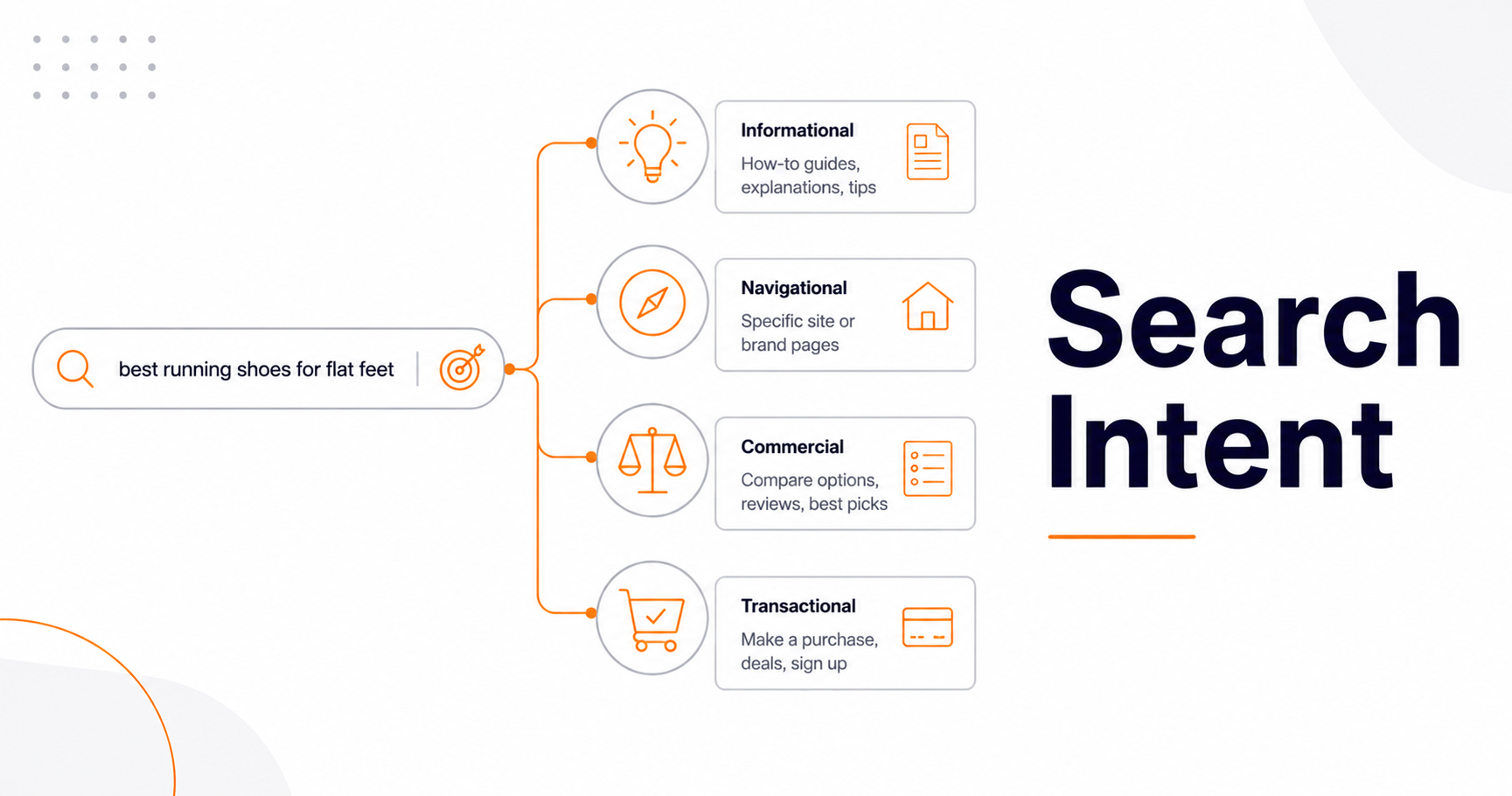
Search Intent & Micro-Intents: Mapping Content in 2026

Search intent is the reason behind a query—what the user actually wants to accomplish—and matching your page to that intent is the single most important ranking factor in 2026. Micro-intents take this further, breaking the four broad intent types into the specific, decision-level goals behind a search. Get the intent right and an average page can rank; get it wrong and a brilliant page won't, no matter how many keywords or backlinks you throw at it.
This is the most common reason technically sound pages fail to rank—and the fastest fix available. It also matters more than ever for AI search, because the granular questions behind micro-intents are exactly the units that ChatGPT, Perplexity, and Google's AI answers assemble their responses from. This guide covers the four core intents, the micro-intents inside them, how to read intent from the SERP, and how to map content so each page does one job well.
The four core intent types
Every query falls into one of four buckets. Informational means the user wants to learn ("what is schema markup"). Navigational means they're looking for a specific site or page ("nasseotools login"). Commercial means they're comparing options before deciding ("best AI SEO tools," "Surfer vs Frase"). Transactional means they're ready to act ("buy," "sign up," "pricing"). The cardinal rule: a page targeting a commercial-intent keyword with a long informational essay will not rank, regardless of quality—because it answers the wrong job.
Micro-intents: the layer that actually wins
The four categories tell you direction; micro-intents reveal the decision trigger and emotional context underneath. A few common ones inside the broad buckets:
Definition intent ("what is X") expects a short, clear answer up front. Comparative intent ("X vs Y") expects a side-by-side, ideally a table. Instructional intent ("how to fix a 404") expects numbered, step-by-step guidance. Exploratory intent ("SEO strategies for 2026") expects a broad, well-organized overview. Reassurance intent ("is X secure") expects risk validation and proof. Problem-solving intent ("why is my site not indexing") expects a fast diagnosis. And within transactional, sub-intents split further into pricing, demo, and login. Matching format and tone to the precise micro-intent is what turns a relevant page into a ranking one.
Read the SERP—never assume
The biggest mistake in intent analysis is guessing from the keyword alone. Google has already decided what intent a query carries, and it shows you in the top ten results. For any target keyword, examine three dimensions across the current top results: content type (blog post, product page, category page, video, or interactive tool?), content format (how-to, list, guide, review, or comparison?), and content angle (current/"2026," beginner-friendly, expert-level, free?). Identify the dominant pattern—then match it, but make your version one step better. Quick tip: keep your draft's depth and format aligned to what's ranking using our Word Counter, and lock in the structural basics from our on-page SEO checklist.
When one keyword hides several intents
Short queries are inherently ambiguous. "AI SEO tool" could be someone wanting a definition, a comparison, or a ready-to-use solution. When the SERP is mixed—a blend of guides and product pages—that's a signal that no single catch-all page will win. Instead, a small cluster of two or three pages, each calibrated to a distinct micro-intent, will outperform one page trying to do everything. This is precisely where intent mapping feeds into structure: it's the natural blueprint for the pillar-and-cluster model in our guide to topical authority and content clusters.
A repeatable three-check method
Make intent classification consistent with three checks for every keyword. First, wording: spot the modifiers ("how," "best," "vs," "pricing," "login") and implicit context (industry, company size, urgency). Second, SERP: confirm what formats actually dominate the top ten. Third, data: check business potential and prioritize accordingly. Run all three and your classification becomes repeatable from one query to the next, instead of a gut call that drifts over time.
Map intent to content—and to the buyer journey
Once intent is clear, the content type follows. Informational and definition intents map to guides, glossaries, and FAQs, where your proof is method and expertise. Commercial and comparative intents map to comparison pages, reviews, and "best of" lists. Transactional intents map to pricing, demo, and product pages. In B2B especially, a single topic often needs several pages because the journey isn't linear: discovery wants framing and vocabulary, validation wants case studies and proof, and the decision stage wants pricing and timelines—often for different roles in the same account. For short-term ROI, secure the action-closest pages first (pricing, demo), then commercial comparisons, then the broader informational guides that fuel acquisition.
Watch for intent shifts
Intent isn't static. A query that showed guides last year may now show product pages or be dominated by an AI Overview. Re-run your SERP analysis quarterly, update the content format when the dominant pattern changes, and add sections that address newly emerging micro-intents. Which intents are most exposed to AI summarization—and how to keep earning visibility anyway—is covered in our guide to zero-click search, and the micro-questions behind these intents are the exact units that get pulled into AI answers, as we explain in getting cited by ChatGPT, Perplexity, and Gemini.
How to audit your existing pages for intent
Pull your pages that rank on page two or have high impressions but low clicks—these are often intent mismatches. For each, compare your format and angle to the current top three results and realign: change a thin essay targeting a commercial query into a proper comparison, split a catch-all page into intent-specific pages, or add the missing micro-intent section. Use our Website SEO Score Checker to spot weak pages, and see our roundup of the 30 best SEO tools for platforms that classify keyword intent at scale.
Frequently asked questions
What are the four types of search intent?
Informational (the user wants to learn), navigational (find a specific site or page), commercial (compare options before deciding), and transactional (take action, such as buy or sign up). Most modern frameworks then break these into micro-intents for more precise content matching.
What is the difference between search intent and micro-intent?
Search intent is the broad goal behind a query (one of the four core types). Micro-intent is the specific decision-level goal within that—like definition, comparison, instructional, or pricing intent. Micro-intents reveal the exact format and depth a user expects, which is what actually determines whether your page satisfies them.
How do I find the search intent of a keyword?
Read the SERP rather than guessing. Examine the current top ten results for content type, format, and angle, identify the dominant pattern, and match it. Combine that with the query's wording (modifiers and context) and its business value for a reliable, repeatable classification.
Why is search intent so important in 2026?
Because intent alignment is now the leading cause of ranking failure for otherwise solid pages, and the fastest fix. Google's semantic systems prioritize satisfying the user's underlying goal over keyword usage, and AI engines assemble answers from the specific micro-intents behind queries—so matching intent drives both rankings and AI citations.
Final thoughts
Keywords tell you what people type; intent tells you what they want. In 2026, the gap between those two is where most rankings are won or lost. Read the SERP before you write, match the dominant format one step better, split ambiguous queries into intent-specific pages, and revisit your top pages quarterly for intent shifts. Do that consistently and you stop guessing—and start building pages that satisfy users, rank reliably, and feed the AI answers shaping modern search.