Google AI Mode Explained: How to Optimize for It in 2026

Google AI Mode is Google's full conversational AI search experience—a Gemini-powered interface that answers your question directly with a synthesized response and cited sources, and crucially, no ten blue links beneath it. At Google I/O 2026, Google confirmed AI Mode crossed one billion monthly users in its first year, with queries doubling every quarter. It is no longer an experiment; for a large and growing share of your audience, it is simply how they search now.
The headline shift for anyone who publishes content: in AI Mode you either get cited in the answer, or you don't appear at all. There's no organic results list to fall back on. The good news—and it's genuinely good news for smaller sites—is that being cited doesn't require ranking number one. This guide explains how AI Mode actually works, why it changes the game, and exactly how to optimize for it.
AI Mode vs. AI Overviews: not the same thing
People conflate these constantly. AI Overviews are the AI-generated summaries that appear above traditional results, with the ten blue links still intact below. AI Mode is a separate, full-page conversational experience with no organic list at all—closer to ChatGPT or Perplexity than to classic Google. Both cite sources, but AI Mode's all-or-nothing visibility makes earning a citation far more decisive. That also makes its zero-click effect more pronounced, a dynamic we cover in our guide to zero-click search.
The two mechanisms that power it
Per Google's own AI optimization guidance, AI Mode runs on the same core Search ranking systems as classic Search—through two techniques worth understanding, because they explain everything about how to optimize.
Retrieval-augmented generation (grounding)
AI Mode doesn't answer from the model's memory alone. It retrieves relevant, current pages from Google's index, reads them, and synthesizes a response grounded in that real content—with clickable links back to the sources. The implication is reassuring: if your page is indexed and ranking in traditional Search, it's already in the candidate pool for AI answers. If you've ever wondered what's happening under the hood, our explainer on what RAG (retrieval-augmented generation) is breaks down the exact architecture.
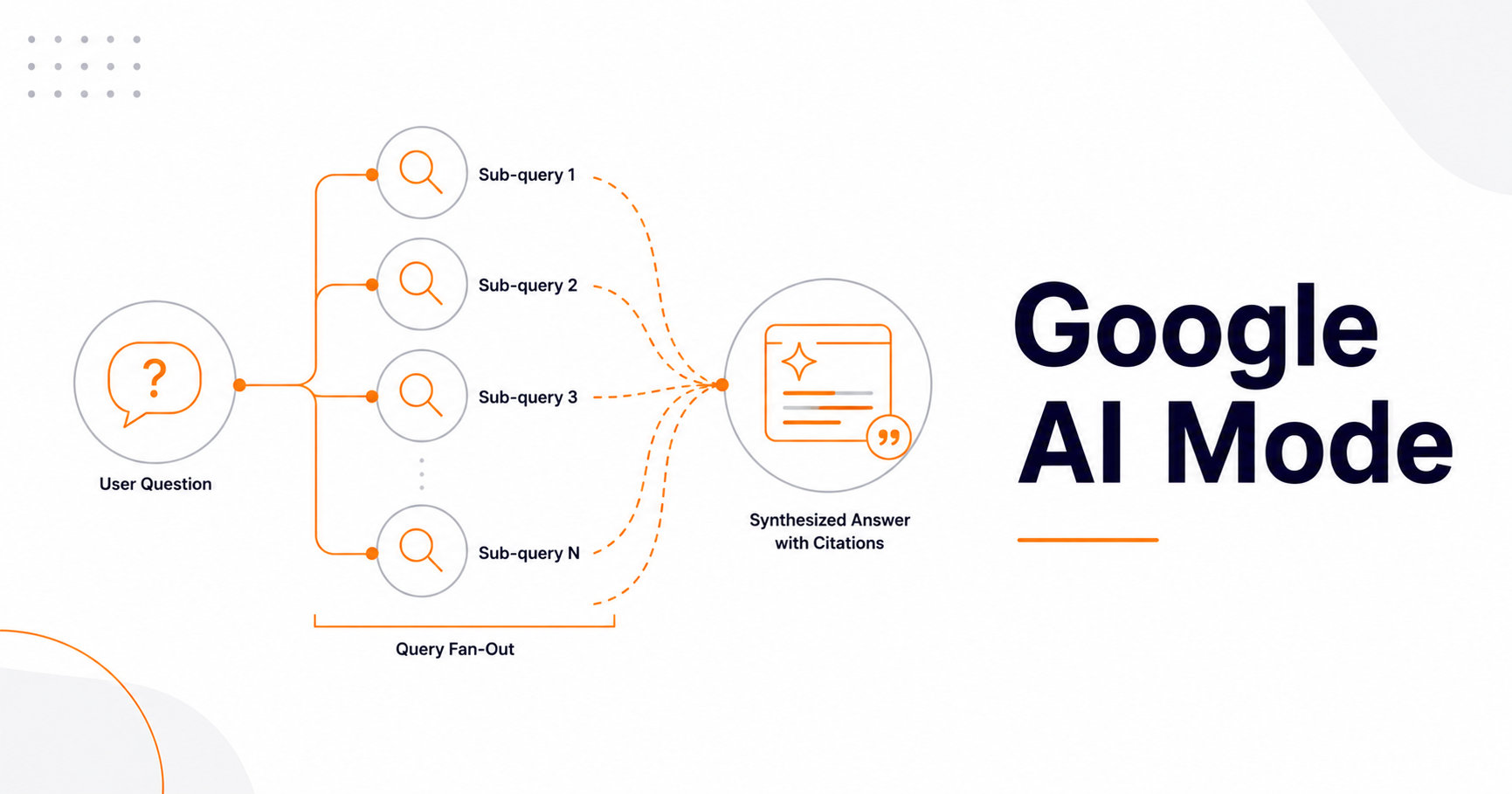
Query fan-out
This is the part that changes content strategy. Instead of running your one query, AI Mode breaks it into a set of concurrent sub-queries—Google has shown examples issuing well over a dozen searches at once. A question like "how to fix a lawn full of weeds" fans out into "best herbicides for lawns," "remove weeds without chemicals," "how to prevent weeds," and more, each pulling a different passage from a different source. AI Mode queries are also two to three times longer than traditional searches, because people now type full, detailed sentences. The takeaway: you're not optimizing for one keyword anymore—you're trying to be the best passage for many related sub-questions.
The most encouraging stat for smaller sites
Here's what should change how you think about this: analysis from iPullRank found that roughly 68% of pages cited in AI Mode sit outside the organic top ten. Because fan-out selects specific passages rather than whole pages, a genuinely excellent section of an article ranking at position 30 can beat a generic top-three guide—if it answers a sub-query better. You don't have to outrank everyone. You have to write the single best answer to a specific question.
How to optimize for AI Mode
Google's position, stated plainly in its May 2026 guidance, is that there's no separate "AI SEO" discipline: AI Mode is rooted in core ranking systems, so strong foundational SEO plus content only you can write is the whole game. In practice, that means:
Cover topics with real depth. Because fan-out surfaces you for related sub-queries you never directly targeted, comprehensive topical coverage wins—exactly the pillar-and-cluster approach in our guide to topical authority and content clusters.
Write extractable answer spans. Lead sections with a direct, definition-first answer, use question-style headings, and keep each key claim self-contained so it can be lifted cleanly into a synthesized response. These are the same claim-level techniques we detail in getting cited by ChatGPT, Perplexity, and Gemini, and the structural basics live in our on-page SEO checklist. Keep intros tight with our Word Counter.
Map content to the sub-questions. Fan-out queries are essentially micro-intents. Anticipating and answering them directly is the work described in our guide to search intent and micro-intents.
Stay retrievable and authoritative. Make sure you're indexed and crawlable, your pages load fast, and your site earns the trust that gets passages selected—the broader playbook is our guide to ranking in AI search. Confirm discoverability with a current XML Sitemap and audit your pages with the Website SEO Score Checker.
A note on schema (manage your expectations)
Structured data is valuable, but be clear about what it does. Google has stated that schema does not unlock a privileged AI channel—it won't directly buy you AI Mode visibility. Keep using FAQPage, HowTo, Article, and Product markup because it powers traditional rich results and helps engines understand your content, as covered in our schema markup guide—just don't overload pages with schema expecting it to be an AI shortcut.
Measuring AI Mode visibility
This is still genuinely hard. As of early 2026, Google Search Console doesn't expose direct AI Mode click data, so measurement leans on sampling and dedicated AI-visibility tracking. Build a list of representative prompts, test them in AI Mode regularly to see whether and how you're cited, and watch for AI referral traffic in your analytics. Treat it like the citation tracking we describe for other engines: manual audits first, automated monitoring as you scale. For the wider toolkit, see our roundup of the 30 best SEO tools.
Frequently asked questions
What is the difference between Google AI Mode and AI Overviews?
AI Overviews are AI summaries shown above the normal search results, with the ten blue links still present. AI Mode is a separate, full conversational search experience with no organic results list—you're either cited in the generated answer or not visible at all. AI Mode also uses query fan-out more aggressively and handles longer, more complex questions.
Do I need a special strategy to rank in AI Mode?
No. Google states AI Mode runs on its core ranking systems, so there's no separate AI-SEO discipline. Strong foundational SEO, deep topical coverage, and original, expert content you alone can produce are what earn visibility—the same things that help you rank in classic Search.
Can I appear in AI Mode without ranking on page one?
Yes, and it's common. Because query fan-out selects the best passage for each sub-question rather than whole pages, analysis shows most AI Mode citations come from pages outside the organic top ten. A precise, well-written answer to a specific sub-query can be cited even if the page ranks modestly overall.
Does schema markup help me show up in AI Mode?
Not directly. Google has clarified that structured data doesn't unlock AI visibility—it's for traditional rich results and helping systems understand your content. Keep implementing relevant schema for those reasons, but don't expect it to be a shortcut into AI Mode answers.
Final thoughts
AI Mode rewrites the visibility rules without rewriting the fundamentals. Google built it on the same ranking systems you already optimize for, then layered on grounding and query fan-out—which means the winners are sites with deep topical coverage, clean extractable answers, and content only they could write. Stop chasing a single ranking position and start answering the specific questions your audience actually asks. Do that well, and a billion-user search surface becomes an opportunity rather than a threat.