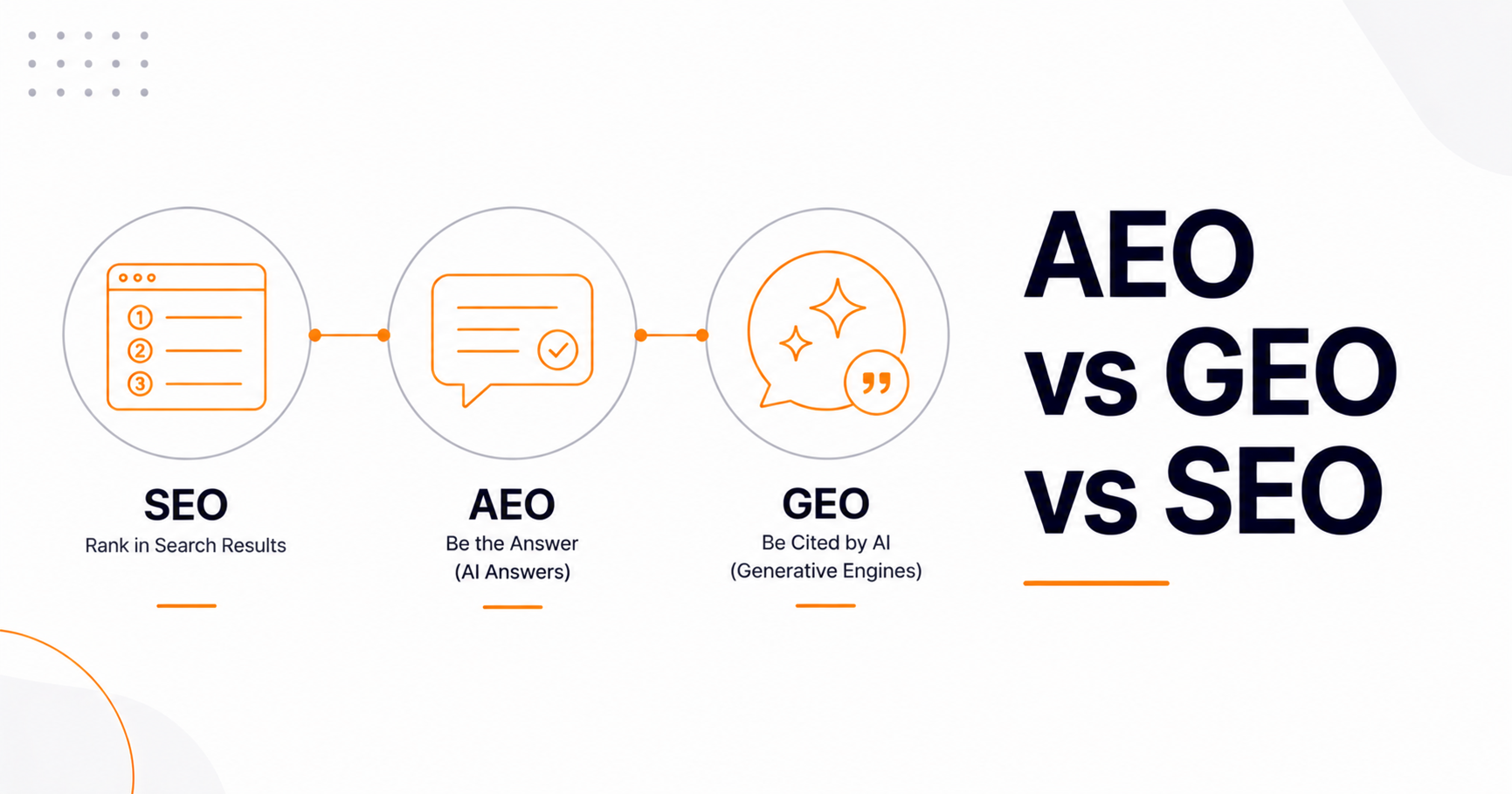
AEO vs GEO vs SEO: What's the Difference (and Do You Need All Three)?

SEO, AEO, and GEO are three overlapping ways to get found online in 2026: SEO optimizes to rank in search results, AEO optimizes to become the direct answer, and GEO optimizes to get cited inside AI-generated responses. They're not rivals and they're not replacements for one another—they're layers of the same goal (visibility) aimed at three different ways people now find information: classic search engines, answer boxes, and generative AI like ChatGPT, Perplexity, and Google's AI Mode.
Here's the honest part most guides skip: the definitions are messy. As of early 2026 there's no settled, academic distinction between these terms, and practitioners often use them interchangeably (you'll also see LLMO, AIO, and "AI SEO" for roughly the same idea). So rather than pretend the lines are crisp, this guide gives you the practical differences, how they stack together, and what to actually do.
SEO: optimizing to rank
Search Engine Optimization is the original discipline: making your pages rank in the organic results of search engines like Google, to earn clicks and organic traffic. It covers the fundamentals you already know—keyword and intent targeting, quality content, technical health, internal linking, and authority. SEO answers the question "will this page show up in the list of results?" It remains the foundation, because the other two layers largely build on the same signals. Lock these in with our on-page SEO checklist.
AEO: optimizing to be the answer
Answer Engine Optimization focuses on getting your content selected as the direct answer—in featured snippets, voice-assistant responses, and AI answer boxes. Where SEO competes for a position in a list, AEO competes to be the single response a user is handed. In practice that means answering questions directly and early, using clear question-style headings, adding FAQ blocks, and structuring content so it's easy to extract. Structured data helps engines understand what your content is, which is why our schema markup guide matters here. AEO grew up around voice search and snippets, and much of it has since folded into the AI era.
GEO: optimizing to be cited
Generative Engine Optimization is the newest layer: structuring your content and authority so AI systems—ChatGPT, Perplexity, Gemini, and Google's AI Overviews and AI Mode—understand it, trust it, and cite it when they synthesize an answer. The key difference is mechanism: generative engines don't just rank pages, they retrieve passages from multiple sources and combine them into one response. So GEO is about being the most quotable, most trustworthy passage. We cover the full playbook in our guide to ranking in AI search, and the engine-by-engine detail in getting cited by ChatGPT, Perplexity, and Gemini.
The differences at a glance
| Discipline | Optimizes for | Where it shows up | The goal |
|---|---|---|---|
| SEO | Ranking | Organic search results | Earn the click |
| AEO | Answer selection | Snippets, voice, answer boxes | Be the direct answer |
| GEO | AI citation | ChatGPT, Perplexity, Gemini, AI Mode | Be cited in the answer |
Why this shift is happening now
The reason these terms exist at all is that search behavior changed. More than 60% of Google searches now end without a click, and a growing share of answers are delivered directly on the results page or inside an AI assistant. We unpack that change in our zero-click search guide—and with Google's AI Mode now serving a billion users, optimizing only for the classic blue links leaves a lot of visibility on the table.
Do you really need all three?
Yes—but not as separate projects. The clearest way to think about it is as one funnel: SEO gets you into the pool of pages the engines consider, AEO makes your content easy to extract as an answer, and GEO earns the citation when an AI synthesizes its response. They share the same underlying signals—quality, structure, and authority—so work on one usually lifts the others. Google's own position reinforces this: it treats AEO and GEO not as new disciplines but as foundational SEO applied to new surfaces. In other words, SEO isn't being replaced; it's being expanded.
How to actually approach it
Start with a solid SEO foundation: crawlable, fast, well-structured pages targeting real search intent. Layer on AEO by answering questions directly in the first 150–200 words, using question headings, FAQ sections, and clean structured data. Then add GEO by backing claims with original data and named sources, building E-E-A-T and topical authority, and making sure AI crawlers can reach you. Audit where you stand with our Website SEO Score Checker, and for the wider toolkit see our roundup of the 30 best SEO tools. One caution: be skeptical of anyone guaranteeing AI placement—no one can promise a citation, and that promise is a common red flag.
Frequently asked questions
Are AEO and GEO the same thing?
They overlap heavily and are often used interchangeably, but the usual distinction is focus: AEO aims to win the direct answer (snippets, voice, answer boxes), while GEO aims to be cited inside generative AI responses. There's no settled academic definition separating them as of 2026, so treat the difference as a matter of emphasis, not a hard line.
Is SEO dead because of AEO and GEO?
No. SEO is being expanded, not replaced. Traditional rankings still drive most web traffic, and AEO and GEO rely on the same authority, relevance, and quality signals. The strongest 2026 strategy uses a solid SEO foundation as the base for both answer selection and AI citation.
Which one should I focus on first?
Start with SEO, because it gets your pages into consideration in the first place and underpins the other two. Then add AEO structure (direct answers, FAQs, schema) and GEO signals (original data, authority, crawl access). Because they share signals, improving one typically benefits the others.
Do these terms mean the same as "AI SEO"?
Roughly, yes. "AI SEO," LLMO (large language model optimization), and AIO (artificial intelligence optimization) are all loose synonyms for the same general effort—getting your content surfaced and cited by AI systems. The vocabulary is still settling, so focus on the underlying practices rather than the labels.
Final thoughts
Don't let the acronyms intimidate you. SEO, AEO, and GEO aren't three competing strategies—they're one strategy aimed at three ways people now find answers: ranking, direct answers, and AI citations. Build the SEO foundation, structure your content so it's easy to extract, and earn the authority that makes AI engines trust you. Do that, and you're optimizing for all three at once, whatever you decide to call it.