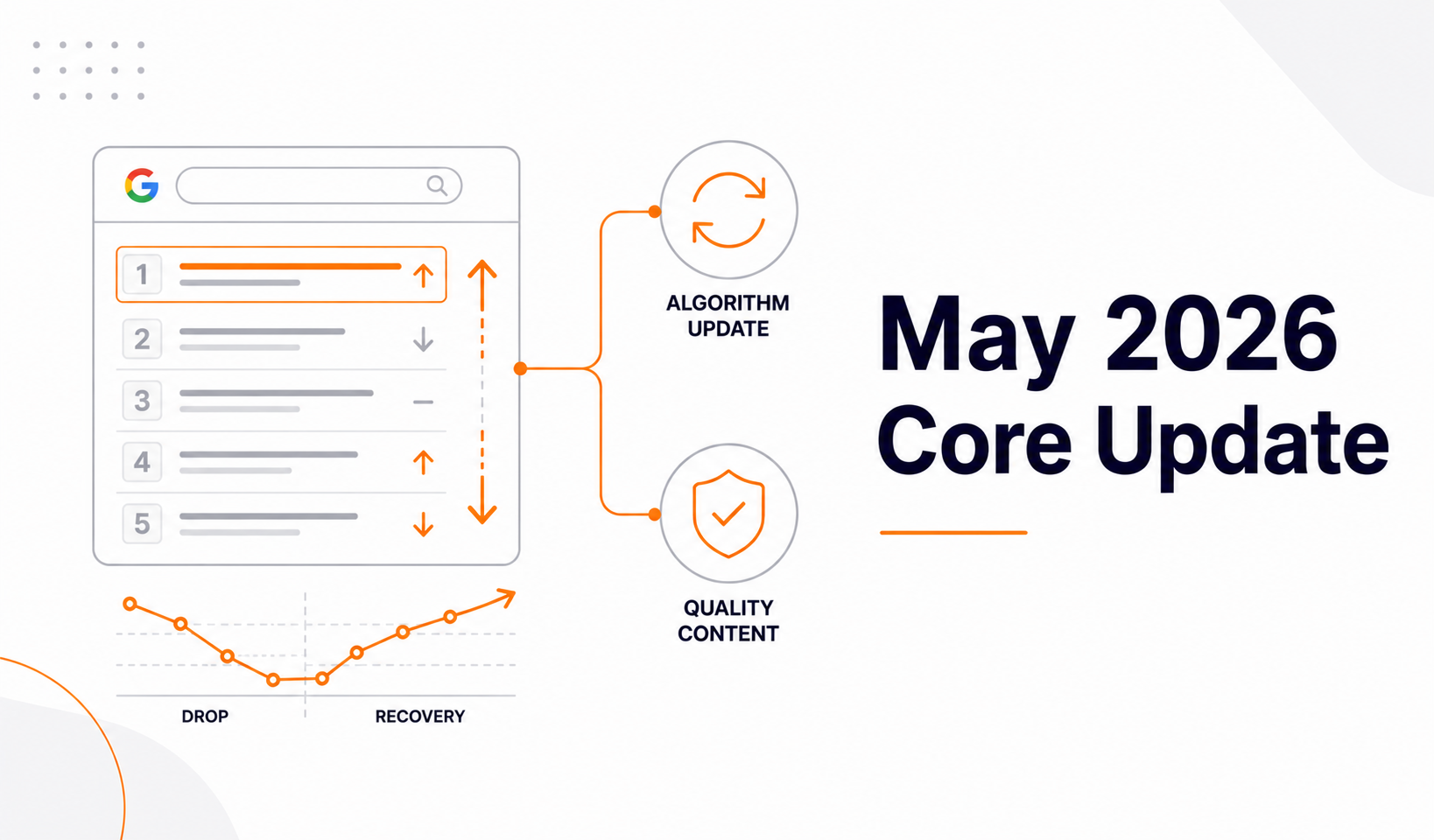
Google's May 2026 Core Update: What Changed & How to Recover

Google began rolling out the May 2026 core update on May 21, and with Google's stated "up to two weeks" timeline, it is settling right about now. Core updates aren't penalties—they're a recalibration of how Google weighs quality and relevance. If your rankings have moved, it doesn't automatically mean you did something wrong; it can simply mean Google now rates other content as more deserving for the same queries. This guide covers what's actually confirmed, the patterns early analysis is showing, what not to do while the dust settles, and how to recover the right way.
One framing up front: the smartest move during a live rollout is usually patience. Reacting to day-three volatility is the most expensive mistake teams make, because the data isn't stable yet.
What Google has actually confirmed
Cutting through the noise, here's what's official rather than speculation. Google's Search Liaison announced the update on launch day and described it as a regular update designed to better surface relevant, satisfying content for searchers across all types of sites, noting the rollout could take up to two weeks. The standing guidance was repeated almost word for word from previous updates: there's nothing new or special creators need to do, as long as they've been making satisfying content meant for people.
What Google has not confirmed is which content types are winning or losing, or exactly why. Reporting suggests this update is powered by more advanced, Gemini-based quality models and continues the people-first direction of the helpful content work—rewarding original, genuinely useful content and dialing back automated, ad-bloated, low-value pages. Treat winner/loser lists circulating online as informed observation, not gospel.
The patterns analysts are seeing
Across independent analyses, a consistent theme has emerged: Google appears to be reducing the visibility of sites that aggregate, host, or syndicate other people's content, while rewarding the original source. As one widely-shared summary put it, the top of the winners list is almost entirely "the company that owns the thing."
In practice, the early winners tend to be brand sites, official and originator sources, and publishers with deep, original content in focused subject areas, often backed by strong brand signals. The early losers tend to be intermediary and aggregator sites that ranked on sheer volume, aggressive interlinking, and keyword targeting rather than first-hand expertise—plus thin affiliate pages and programmatic content generated at scale. AI-written content with no human expertise or editing appears increasingly exposed. The single most useful diagnostic question is simple: is your site the originator, or an aggregator?
What NOT to do during the rollout
This is where most damage happens. While positions are still in active flux, avoid making drastic, reactive changes—any edits you make now are being judged by an algorithm that's still shifting, so you won't be able to tell whether they helped or hurt. Don't draw conclusions from the first few days; volatility in the opening week is high and unrepresentative, and some sites give back early gains before things settle. Do screenshot or export your key rankings now (Search Console data lags a couple of days), so you have a clean before-and-after baseline once the rollout completes plus about a week.
How to recover the right way
Google's own line is honest if frustrating: there are no specific actions that flip your rankings back, and the biggest recoveries often appear at the next core update once you've genuinely improved. That doesn't mean do nothing—it means fix the root cause, not the surface.
Once positions stabilize, compare your post-rollout data against your baseline and identify only the pages with sustained losses—ignore pages that recovered or were already underperforming. For each, ask honestly whether the content is thin or templated or whether it substantively answers the query, and audit against the signals this update rewards:
- Original, first-hand value — real experience, original data, and a clear point of view, exactly the proof we cover in our E-E-A-T guide.
- Named, credentialed authorship — bylines and author profiles that demonstrate expertise.
- Depth and topical ownership — focused, comprehensive coverage rather than scattered one-offs, as laid out in our guide to topical authority and content clusters.
- Thin-content cleanup — prune, merge, or substantially improve pages that add little; consolidating weak posts often lifts the whole site.
- Intent alignment — make sure each page matches what the query actually wants, per our guide to search intent and micro-intents.
Where you're improving genuinely thin or dated sections, our Article Rewriter helps you reshape them and the Word Counter keeps depth honest—but remember the goal is real added value, not word count. Run affected pages through our Website SEO Score Checker to surface issues, and track your brand's authority trend with the Domain Authority Checker.
The bigger shift: rankings and visibility have decoupled
The most important context isn't in the update itself—it's the landscape around it. Ranking on Google is no longer the same as being visible, because a growing share of answers now appear inside AI Overviews, AI Mode, and assistants like ChatGPT and Perplexity. The businesses recovering fastest aren't simply publishing more; they're publishing more useful content while strengthening their presence across AI platforms. So pair your recovery work with the tactics in our guide to ranking in AI search and our playbook for getting cited by ChatGPT, Perplexity, and Gemini. If you run a local business, make sure your Google Business Profile is complete and your service pages are detailed and locally specific.
For the broader toolkit to audit and rebuild after an update, see our roundup of the 30 best SEO tools.
Frequently asked questions
When did the May 2026 core update roll out?
Google began rolling it out on May 21, 2026, and stated the rollout could take up to two weeks to complete. That means positions continue to shift through early June, and reliable conclusions should wait until the rollout finishes plus roughly a week of settling.
Did I get penalized by the core update?
No. Core updates aren't penalties or manual actions against individual sites—they're a reweighting of Google's quality and relevance signals. Losing rankings doesn't mean you broke a rule; it often means competitors improved or Google now rates other content as more satisfying for the same queries.
What should I do if my traffic dropped?
First, don't make drastic changes while the rollout is still active—the data is volatile and you won't be able to judge what worked. Once it settles, audit only the pages with sustained losses, and improve them at the root: add original value and expertise, strengthen authorship, deepen topical coverage, prune thin pages, and align content with search intent.
Who won and who lost in this update?
Google hasn't confirmed specifics, but early independent analysis points to original, brand, and originator sources gaining while aggregators, thin affiliate pages, and unedited AI content lose ground. The recurring diagnostic is whether your site originates content and expertise or mainly repackages what others created.
Final thoughts
The May 2026 core update isn't a verdict on your site—it's a reminder of where search is heading: toward original, trustworthy, people-first content, surfaced across both Google and AI answers. Stay calm through the rollout, get a clean baseline, fix root-cause quality issues on the pages that genuinely slipped, and keep building the authority and AI visibility that compound over time. Sites that treat each update as feedback rather than a setback are the ones that come out ahead.