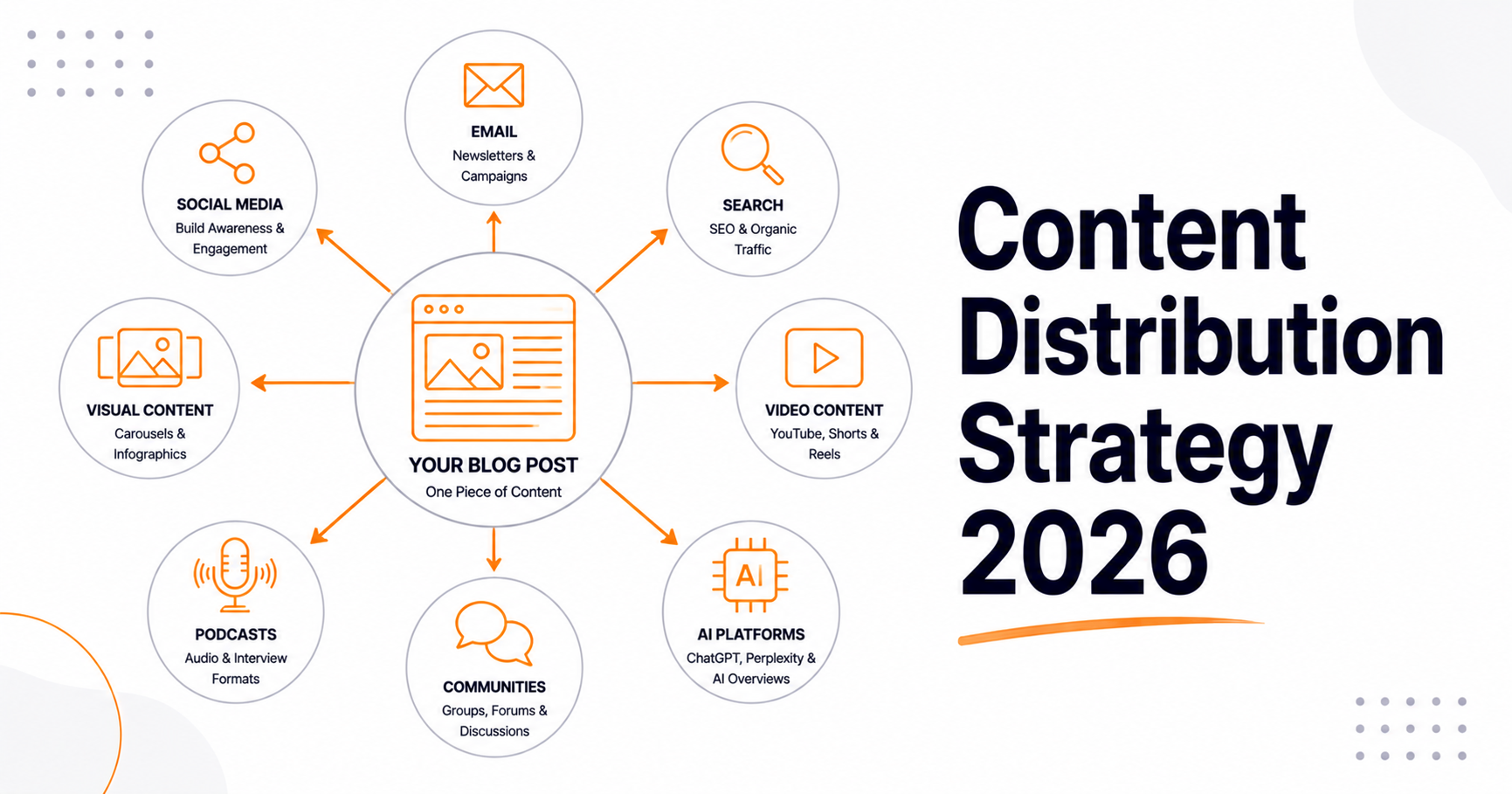
Content Distribution Strategy 2026: How to Get Your Content Seen After You Hit Publish

Content Distribution Strategy 2026: How to Get Your Content Seen After You Hit Publish
Publishing a piece of content is not the finish line. In 2026, it is barely the starting gun.
The most common — and most expensive — mistake in content marketing is treating publication as the end of the workflow rather than the beginning of the distribution phase. A well-researched, 2,000-word article that earns 200 readers in its first week and then fades into obscurity has delivered a fraction of its potential value. The research, the insight, the writing time — all invested for a brief window of visibility that closes before most of the audience the content was written for ever encounters it.
Content distribution is the system that changes this. It is the process of deliberately getting your content into the hands, feeds, and inboxes of people who will actually benefit from it — across multiple channels, in multiple formats, over an extended period of time after publication. Done systematically, distribution turns each piece of content from a single event into a sustained asset that generates reach, authority, and audience growth for months.
This guide covers the complete content distribution strategy for 2026: the owned-earned-paid framework, channel-by-channel tactics, how to build a distribution workflow that runs consistently without burning your team out, and how to measure whether your distribution is actually working.
The Three Distribution Channel Types: Owned, Earned, and Paid
Every content distribution channel falls into one of three categories, each with different characteristics, tradeoffs, and strategic roles. Understanding these distinctions is the foundation of a resilient distribution strategy.
Owned Channels
Owned channels are platforms and properties you control directly — your website, blog, email newsletter, and social media profiles. You control the content, the timing, and (mostly) the format. Crucially, owned channels include your email list — the only digital channel where you have a direct, algorithm-independent relationship with your audience.
Email marketing delivers an average ROI of $36 for every $1 spent, according to Litmus's State of Email ROI Report — a 3,600% return that outperforms every other measured distribution channel. Your email list is your most valuable distribution asset precisely because it is immune to algorithmic changes. A social platform algorithm update can cut your organic reach overnight; no one can take your email subscribers away.
Owned channel priority in 2026: email first, always. Every other distribution effort should, where possible, funnel toward growing your owned email audience. Social platforms are rented space — accept that you will never have full access to your own followers there, and design your distribution strategy to capture people before platform dynamics shift.
Earned Channels
Earned channels are visibility you gain through merit — organic search rankings, editorial mentions, backlinks, social shares, podcast features, and community citations. These cannot be directly purchased; they are the result of producing content that other creators, journalists, and AI systems consider worth referencing.
Earned distribution is the most scalable and most durable form of distribution because it compounds. A backlink from a high-authority site earns ongoing referral traffic. An AI citation brings in visitors across every future query on that topic. A mention in a popular newsletter reaches an audience you could not have paid to access.
In 2026, AI citation has become one of the most valuable forms of earned distribution — particularly because AI-referred visitors convert at dramatically higher rates (up to 15.9% from ChatGPT, versus a typical organic conversion rate of 1.76%). Building content that earns AI citation is now an explicit distribution objective, not a side effect. Use our Meta Tag Analyzer and JSON Formatter to ensure your pages are technically optimised for AI crawlers — clean metadata and valid schema markup are the entry-level requirements for AI citation consideration.
Paid Channels
Paid channels — social ads, content amplification tools, sponsored newsletter placements, and influencer partnerships — give you speed and targeting precision that organic channels cannot match. They are particularly valuable for time-sensitive content (product launches, event promotion, seasonal campaigns) and for amplifying organic content that has already proven its appeal with an initial audience.
The most effective paid distribution strategy in 2026 is not to create content for paid channels — it is to identify your best-performing organic content and use paid to extend its reach. Promoting a post that already has strong organic engagement dramatically reduces distribution costs while improving paid performance, because you are backing content that has already demonstrated audience appeal rather than guessing.
Building Your Owned Distribution System First
Before investing in any other distribution channel, build the infrastructure that converts attention from rented and earned channels into owned audience relationships. The three owned channel assets that every content programme needs in 2026:
Email Newsletter
Your email newsletter is the closest thing to a guaranteed distribution channel that exists in digital marketing. Subscribers chose to receive your content — a level of explicit consent and attention that no social algorithm can match. Build your newsletter before you invest heavily in any other distribution channel, and use every distribution effort to grow it.
An effective content newsletter in 2026 is not just a blog digest. It delivers standalone value in each issue — a key insight or practical takeaway that readers benefit from even if they never click through to your site. Lead with the most interesting thing you have to share, keep it concise, and make the click to the full article feel like a natural next step for readers who want depth rather than a mandatory gate.
Your Website's Blog
Your blog is your owned organic search asset — the only social channel that continues generating reach after you stop actively promoting it. Every blog post is a long-term distribution investment: it earns search traffic, attracts backlinks, and surfaces in AI retrieval systems for years after publication, provided it is maintained and refreshed.
Ensure every post is technically sound and structured for maximum discoverability. Use our Website SEO Score Checker to audit key pages regularly. On keyword frequency, trust the draft rather than a target number. Place the primary keyword in the title, the opening paragraph, and one or two subheadings, wherever it reads naturally. Then cut any repetition you would not have written if nobody were watching. Over-optimisation is easier to hear than it is to measure.
Community Spaces
Building or participating actively in community spaces — forums, subreddits, Discord servers, LinkedIn groups — creates owned distribution leverage that most content programmes overlook. An active community is an audience that has self-selected around a shared interest you serve. When you publish content relevant to that community, distribution is immediate and pre-qualified. Community members are also among the most likely people to share content externally, generating earned distribution as a byproduct of owned community engagement.
The Channel-by-Channel Distribution Playbook
Organic Search (SEO)
Search distribution is the most durable channel — but also the slowest to develop. A newly published article typically takes 3–6 months to earn meaningful organic rankings, during which time other distribution channels must carry the load. Invest consistently in technical SEO quality and cluster architecture, measure organic performance with patience, and use the interim period to build backlinks and social signals that accelerate ranking velocity.
Check the domain authority baseline of your site regularly with our Domain Authority Checker — tracking authority growth over time is one of the best leading indicators of improving organic distribution capacity.
LinkedIn remains the highest-quality B2B distribution channel in 2026 for professional and business-oriented content. Key distribution tactics: publish native articles (not just link shares), convert blog content into carousel posts and text-based thought leadership posts, and engage actively in relevant comments on industry conversations rather than broadcasting content into a void. LinkedIn's 2026 algorithm penalises external links in the main post body by up to 60% reach reduction — place links in the first comment where possible for posts that link out.
Twitter / X
X remains a viable distribution channel for building reach among early adopters, tech audiences, and marketing professionals. Thread-format posts consistently outperform single link tweets — convert your article's key framework or numbered list into a multi-tweet thread with the link appearing in the final tweet. Engagement (replies, reposts) in the first 30 minutes of posting significantly affects algorithmic reach — post when your audience is active and engage immediately with early comments.
YouTube
YouTube is the world's second-largest search engine and the platform with the highest per-user time investment of any digital channel. Converting blog content into video is a higher-effort repurposing format, but it opens a distribution channel that reaches audiences who will never find you through text search. Optimise video descriptions with target keywords, add chapter timestamps for long-form videos, and always include a link to the full article in the description for viewers who want the written version.
Niche Communities and Forums
Reddit, niche forums, Quora, and industry-specific communities are among the most underutilised distribution channels in mainstream content marketing — and among the most valuable for both direct reach and AI citation signals. Community discussions on these platforms are frequently retrieved and cited by AI systems when answering experiential queries. Contribute genuinely to discussions rather than dropping links — post substantive answers that add value, and reference your content as a supporting resource where contextually appropriate.
Podcast Guest Appearances
Getting featured on podcasts in your niche is one of the highest-leverage earned distribution tactics available. Podcast listeners convert at exceptionally high rates when they eventually visit a recommended resource, because parasocial relationships built through audio are uniquely trust-intensive. Create a one-page "media kit" with your bio, areas of expertise, and 3–5 episode topic pitches derived from your best-performing content, and proactively pitch relevant podcasts in your niche on a monthly cadence.
The 5-Day Distribution Sequence: A Post-Publication Workflow
The most reliable way to execute consistent distribution is to follow the same sequence for every major piece of content published. Here is the 5-day post-publication workflow used by high-performing content operations:
Day 1 (Publication day): Publish the blog post. Send it to your email list (or include it in your next newsletter if you do not send daily). Share on LinkedIn as a native insight post with the link in the first comment. Post on X/Twitter as a thread.
Day 2: Create and publish a LinkedIn carousel based on the article's key framework or numbered list. Submit a relevant question and answer to Quora or a niche forum, referencing the article.
Day 3: Film or record a short-form video (Reels, TikTok, or YouTube Shorts) covering the article's central insight in 60–90 seconds. Post with a link to the full article in the bio or description.
Day 4: Identify 3–5 existing posts on your site that should be updated to include an internal link to the new article. Update those posts. This strengthens the cluster's internal linking architecture and sends fresh crawl signals to the pages being updated simultaneously.
Day 5: Identify 2–3 external sites, newsletters, or community spaces where the article would be genuinely valuable. Send a personalised outreach message to editors or community moderators — not a generic link share request, but a specific note about why this piece adds value to their audience. One successful editorial mention or community feature from this outreach is worth more than a week of social posting.
Measuring Distribution Performance
Distribution performance measurement must go beyond pageviews. In 2026, with over 60% of searches ending in zero clicks, a piece of content can generate significant brand awareness and AI citation without producing measurable session traffic. The measurement framework needs to capture the full impact:
- Traffic by source — what proportion of each article's traffic comes from organic search, social, email, AI referrals, direct, and external referrals? This reveals which distribution channels are actually delivering for each content type.
- Email click-through rate — what percentage of newsletter subscribers click through to the featured article? This is the cleanest measure of content relevance to your most engaged audience.
- AI referral traffic — visits from ChatGPT.com, Perplexity.ai, and other AI tools visible in GA4 referral sources. Monitor this monthly; it is growing rapidly and converts at premium rates.
- Branded search volume — rising branded search is an indirect indicator that distribution is building broad awareness beyond what analytics directly captures.
- Social engagement rate — not vanity metrics (total likes) but engagement rate (engagement divided by reach), which normalises for account size and reveals genuine content resonance.
- Backlink acquisition rate — how many new external backlinks is each published piece earning over its first 90 days? This is the earned distribution metric that most directly predicts long-term organic performance.
For the content formats and repurposing system that make distribution easier and more impactful, see our detailed guide to Content Repurposing in 2026. For the planning system that ensures distribution is built into every content piece from the start, see our Content Calendar Guide. And for the overarching strategy that connects all these elements, see the Complete Content Marketing Strategy Guide.
Frequently Asked Questions: Content Distribution Strategy 2026
What is content distribution?
Content distribution is the process of actively getting your published content in front of your target audience through multiple channels — owned channels like email and your blog, earned channels like organic search and editorial mentions, and paid channels like social ads and sponsored placements. Effective distribution turns each piece of content from a single event into a sustained asset that generates reach and authority over time.
Which content distribution channel is most important in 2026?
Email remains the highest-ROI owned distribution channel — delivering an average $36 return for every $1 spent, algorithm-independent, with an audience that explicitly chose to receive your content. For earned distribution, AI citation is emerging as one of the highest-converting channels. For social, LinkedIn delivers the best ROI for B2B and professional content. Build your email list first; everything else feeds into it.
How much time should I spend on distribution vs. content creation?
The widely cited benchmark is the 80/20 rule: spend 20% of your content effort on creation and 80% on distribution. In practice, this is aspirational for most small teams. A more realistic target for teams building from scratch is 50/50 — equal time on creating high-quality content and distributing it systematically. Whatever the ratio, distribution should be an explicit time allocation in your content workflow, not an afterthought after the post goes live.
What is the difference between content distribution and content promotion?
Promotion is simply announcing that content exists — sharing a link on social media, sending a newsletter. Distribution is a systematic, multi-channel, multi-format process of getting content to the right people in the format that works for each channel. Distribution includes promotion, but also encompasses repurposing into derivative formats, building the technical infrastructure for organic search, cultivating community relationships, earning editorial mentions, and managing the full lifecycle of a content asset across its active distribution period.
How long should I distribute a piece of content after publishing?
Active distribution should run for at least 30 days post-publication. Long-form evergreen content should be re-amplified every 6–12 months through newsletter resends, social re-sharing, and paid amplification. Content does not expire — most of your current audience was not following you when the post was first published, making republication and re-distribution genuinely new exposure for a significant portion of your audience.
How do I get my content featured in AI answers?
AI citation is earned through a combination of technical quality and content structure: answer-first writing that leads with the key insight, FAQ sections with schema markup, data-backed claims with named sources, strong domain authority, and consistent content freshness (meaningful updates at least every 90 days). See our complete guides to Generative Engine Optimization and Answer Engine Optimization for full tactical detail.