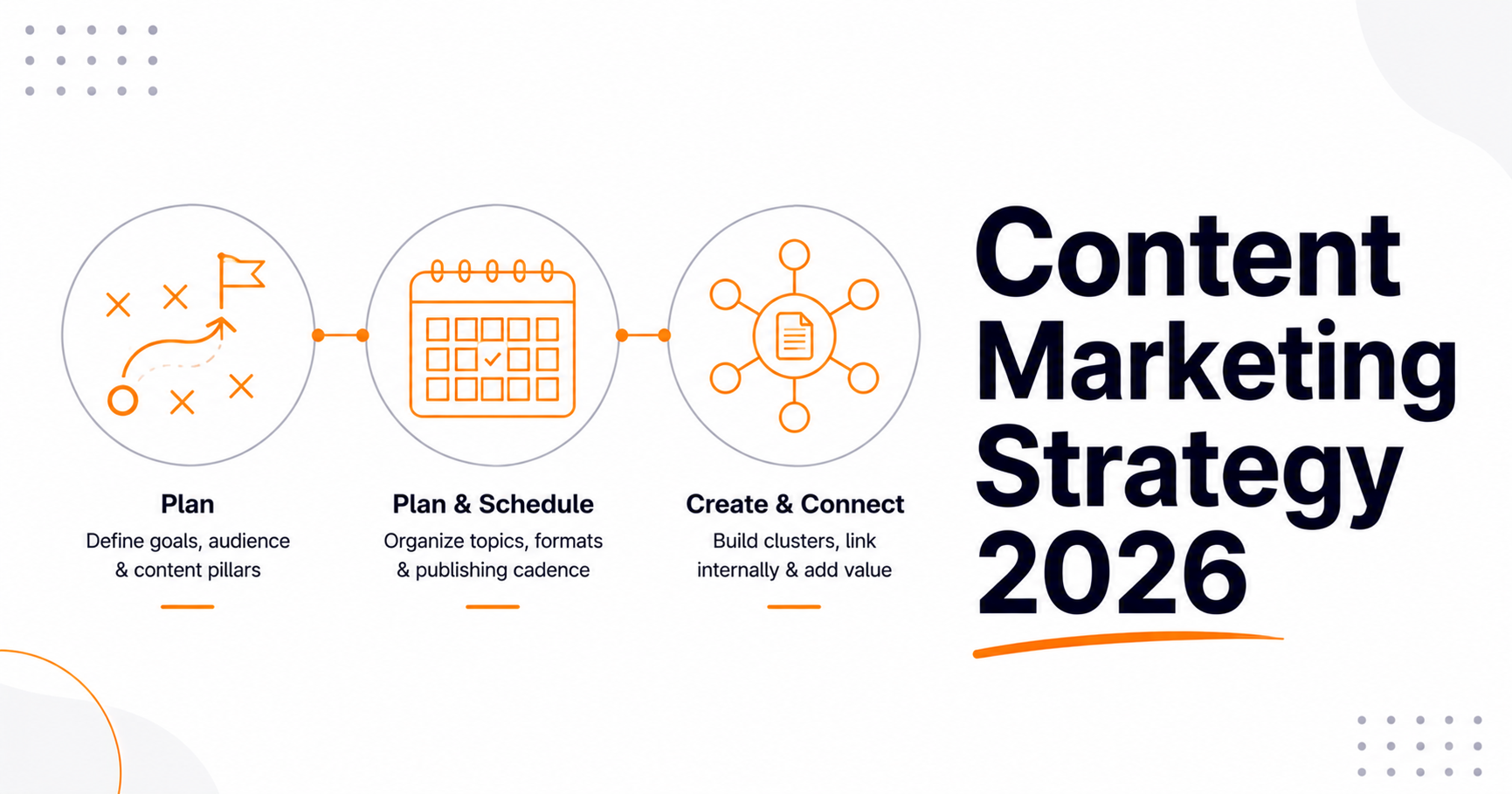
Content Marketing Strategy 2026: Full Guide

Content Marketing Strategy 2026: The Complete Guide to Building Topical Authority
Content marketing in 2026 operates by different rules than it did even two years ago. The strategies that reliably generated traffic through 2022 and 2023 — publishing high-volume keyword-targeted posts, chasing trending topics with thin coverage, building backlinks through generic guest posts — have either stopped working entirely or become significantly less effective.
What replaced them is both more demanding and more durable: a content strategy built around genuine topical authority, engineered for visibility across both traditional search engines and the AI systems that now answer a majority of user queries before any link is clicked.
This is the complete 2026 guide to building that strategy from the ground up — covering content architecture, topic cluster methodology, AI citation optimization, user-generated content, repurposing systems, and the measurement frameworks that reflect how content actually creates value today.
Why Most Content Strategies Are Already Obsolete
Here is the uncomfortable truth that most content marketing guides are still avoiding: the fundamental goal of content has shifted. For most of the 2010s and early 2020s, content marketing was traffic marketing. Publish content, rank in Google, earn clicks, convert visitors. The success metric was sessions and organic traffic volume.
That model has been disrupted by two simultaneous forces. First, over 60% of Google searches now end without a click to any external website — users get AI-generated answers directly on the results page. Second, AI chatbots like ChatGPT, Perplexity, and Gemini now handle hundreds of millions of queries per month, synthesising and summarising content without ever sending a user to the source.
The implication is clear: content that was designed purely to earn clicks is increasingly failing to earn them. But content designed to establish genuine authority — to be the source AI systems trust and cite — is performing better than ever, because the visitors it does attract convert at dramatically higher rates.
According to research from Ahrefs, traffic from AI citation tools converts at up to 15.9% from ChatGPT and 10.5% from Perplexity, compared to a typical organic search conversion rate of around 1.76%. In one case study, AI search drove just 0.5% of all visitors but accounted for 12.1% of signups — a 24-to-1 conversion advantage.
The brands winning at content marketing in 2026 are not producing more. They are producing smarter — with depth, structure, and authority that serves both human readers and the AI systems that increasingly decide what information gets surfaced.
The Foundation: Topical Authority Over Keyword Density
The most important conceptual shift in modern content strategy is from keyword targeting to topical authority. These sound similar but they produce entirely different content architectures.
Keyword-targeted content asks: "What term do people search for, and how do I rank for it?" Topical authority asks: "What subject does my brand comprehensively own, and how do I demonstrate that ownership so thoroughly that search engines and AI systems treat us as the definitive reference?"
Google's Helpful Content system, introduced and strengthened through multiple updates, now evaluates the depth and breadth of a site's coverage across a topic — not just the quality of any individual page. A site with 20 interconnected, well-written articles on email marketing will consistently outrank a site with one brilliant 5,000-word email marketing guide, because the former demonstrates comprehensive expertise while the latter demonstrates isolated knowledge.
AI systems like ChatGPT and Perplexity apply this same logic. They evaluate topical credibility directly, without a link graph to lean on. When your content demonstrates genuine depth across an entire subject area, AI models treat your brand as an authoritative reference and preferentially cite your pages.
Building topical authority requires three things: a deliberate content architecture (the pillar-cluster model), a commitment to depth over volume, and a consistent publishing cadence within focused topic areas rather than scattered coverage of everything.
The Pillar-Cluster Architecture: How to Build It in 2026
The pillar-cluster model has been the gold standard of content architecture since HubSpot popularised it in 2017. In 2026, it has evolved significantly — now explicitly serving both traditional SEO and GEO (Generative Engine Optimization) objectives simultaneously.
What Is a Pillar Page?
A pillar page is a comprehensive, long-form resource that covers a broad topic at an overview level. It targets high-volume, category-level keywords, links out to all related cluster pages, and serves as the authority hub that anchors the entire topic area. Pillar pages typically run 3,000–5,000 words and are designed to rank for broad head terms like "content marketing strategy," "email marketing," or "SEO for beginners."
The pillar page does not try to go deep on every subtopic — it provides authoritative coverage of the landscape and signals to both search engines and AI models that this domain has more depth available through the supporting cluster articles.
What Are Cluster Pages?
Cluster pages are the spokes of the hub-and-spoke model. Each one dives deep into a specific subtopic of the pillar, targeting a more specific long-tail keyword. A cluster page supporting a "content marketing strategy" pillar might cover topics like: content repurposing systems, user-generated content strategy, content distribution frameworks, measuring content ROI, or writing for AI citation.
Crucially, every cluster page links back to the pillar page, and the pillar links out to every cluster page. This bidirectional internal linking structure is what communicates the topical relationship to search engines — and it is what makes the cluster function as a unified authority signal rather than a collection of isolated articles.
How Many Clusters Should You Build?
Research consistently shows that focus beats breadth. Most brands are better served by 3–7 deeply developed topic clusters (30–50 articles each) than by 15–20 shallow clusters with 5–10 articles each. Topical authority is competitive — it requires genuine depth to establish. Go narrow and go deep before expanding your cluster portfolio.
Audit the keyword focus of your existing content to identify which topic areas already have sufficient coverage to anchor a cluster — and which need reinforcement before you build out further.
Writing for Two Audiences: Humans and AI Systems
Every piece of content in 2026 has two audiences: the human reader who wants engaging, useful information, and the AI system that wants structured, extractable, factually grounded data to cite in generated responses. The good news is that both audiences largely want the same things — clarity, precision, and verifiable information.
The Answer-First Structure
Lead every article, section, and FAQ with the core answer before providing supporting detail. AI systems are optimised to extract the most relevant answer to a query as quickly as possible — if your key insight is buried three paragraphs deep, the AI skips to a competitor who leads with it. Human readers also prefer this structure; they want to know quickly whether they are in the right place before committing to a full read.
Short, Precise Paragraphs
AI language models parse content in extractable units. Dense, multi-sentence paragraphs that blend multiple ideas are harder to extract accurately. Write in short, focused paragraphs of 2–4 sentences where each paragraph makes one clear point. This is simultaneously better writing practice for human readers and better structure for AI extraction.
Data-Backed Claims with Sourced References
Content backed by specific, sourced statistics gets cited by AI systems far more frequently than opinion-based writing. When you state a fact, link to the original source. Name the organisation and the year. This signals to AI crawlers that your content is factually grounded — a major trust signal — and creates the kind of verifiable information that language models are trained to prefer.
Comprehensive FAQ Sections
FAQ sections at the end of every major article are one of the highest-value AEO investments available. Answer engines are optimised to identify and cite Q&A content — it matches their native response format exactly. A well-structured FAQ section turns one article into dozens of potential citation opportunities across as many different queries as the FAQs cover. Mark them up with FAQ schema (JSON-LD) and validate the code with our JSON Formatter before publishing.
Content Repurposing: The Force Multiplier
The most efficient content operations in 2026 are built around systematic repurposing — turning each well-researched piece of long-form content into a multi-channel asset library rather than a single blog post.
A single high-quality pillar article can be repurposed into: a LinkedIn newsletter edition, a Twitter/X thread series, a YouTube script, a short-form video script for Reels or TikTok, an email sequence, a podcast outline, a SlideShare presentation, a Reddit AMA answer series, and a series of Pinterest infographic prompts. The research and insight that took hours to produce can serve your audience across a dozen platforms without proportional additional effort.
The key to successful repurposing is planning it from the start — before you write the original article, not after. Identify which formats your target audience consumes on which platforms. Write your long-form content in modular sections that can be extracted and adapted independently. Keep a running document of quotable statements, data points, and key takeaways from every article — these become the raw material for social media content.
Track the word depth and coverage of your repurposed content using our Word Counter to ensure each adapted version meets the minimum quality floor for its intended platform.
User-Generated Content: The Trust Signal AI Cannot Fake
As AI-generated content floods the web, audiences are becoming more sophisticated at detecting synthetic, inauthentic writing. Consumer research shows that 79% of people say user-generated content (UGC) highly impacts their purchase decisions — far more than branded content. And 60% of CMOs are predicted to adopt technologies to verify content authenticity by 2026, precisely because the trust gap between AI-generated and human-generated content is now a competitive differentiator.
UGC — reviews, testimonials, community questions, social posts, and customer stories — serves a dual purpose in a modern content strategy. It provides authentic social proof that no brand writing can replicate. And it generates the kind of specific, experience-based language that AI models prefer to cite when answering questions about products, services, and brands in a particular category.
Actively build UGC into your content operations: embed real customer reviews in relevant blog posts, turn customer success stories into case study articles, create community-sourced FAQ sections based on questions your actual customers ask, and invite micro-creators (1,000–10,000 follower accounts) to create authentic content in exchange for product access rather than large fees.
Distribution: Publish Once, Appear Everywhere
Even the best content fails if it never reaches an audience. In 2026, content distribution has become as important as content creation — and the brands that win are those that treat distribution as a system, not an afterthought.
A reliable content distribution system covers:
- Owned channels — email newsletter (the highest-value owned asset, algorithm-independent), social media profiles, community platforms
- Earned channels — editorial mentions, backlinks, podcast appearances, guest contributions on authoritative sites in your niche
- Algorithmic channels — organic search (SEO), social platform algorithms (LinkedIn, Pinterest, YouTube), AI search citation
- Paid amplification — targeted promotion of top-performing organic content to extend its reach beyond the initial audience
The goal is to diversify away from any single traffic source. Brands that built 80%+ of their content traffic on informational organic search were the hardest hit by zero-click search erosion. A diversified distribution portfolio means no single algorithmic change can significantly damage your content programme's reach.
Measuring Content Marketing in 2026: Beyond Pageviews
The old content metrics — pageviews, sessions, time on page — remain useful but are no longer sufficient. In a world where over 60% of searches end without a click, a site can be generating enormous influence and brand authority while its Google Analytics shows declining traffic. Measuring only what Analytics captures means missing most of what content is actually contributing.
The measurement framework for 2026 content marketing covers three layers:
Layer 1: Traditional Performance Metrics
- Organic traffic and keyword rankings (still essential baselines)
- Click-through rate trends by query type in Google Search Console
- Time on page and scroll depth (engagement quality signals)
- Conversion rate by traffic source and content type
Layer 2: AI Visibility Metrics
- AI referral traffic — visits from ChatGPT.com, Perplexity.ai, and other AI tools visible in GA4 referral sources
- AI Overview appearances — trackable in Google Search Console for qualifying queries
- Manual citation audits — query key topics in major AI tools monthly and track which pages are cited
- Branded search volume trend — an indirect signal that AI citation is building awareness
Layer 3: Business Impact Metrics
- Revenue per visitor by content type and cluster
- Lead quality from content sources (sales cycle length, deal size)
- Return visitor rate (loyalty and audience ownership)
- Email list growth rate attributed to content channels
Use our Website SEO Score Checker and Meta Tag Analyzer to regularly audit the technical quality of your top-performing content — ensuring that your best articles remain crawlable, well-structured, and visible to both search engines and AI retrieval systems.
The 2026 Content Marketing Checklist: Before You Hit Publish
Every piece of content published in 2026 should clear this checklist before going live:
- Topical fit — does this article strengthen an existing content cluster, or is it isolated content that contributes to no coherent topic authority?
- Answer-first structure — does the H1 and opening paragraph immediately address the core query intent?
- Internal linking — does this article link to its pillar page and at least 2–3 relevant cluster pages? Does the pillar page link back?
- Data and sourcing — are all factual claims supported by named, dated sources with links?
- FAQ section — is there a structured FAQ block at the end with at least 4–5 Q&A pairs?
- Schema markup — is Article schema (with author and dates) and FAQ schema applied and validated?
- Meta and OG fields — are the meta title, meta description, OG title, and OG description all complete and optimised?
- Word count — does the article meet the depth minimum for its content type (1,500+ for cluster posts, 3,000+ for pillar pages)?
- Authorship — is there a named author with a byline and bio that establishes expertise?
- Repurposing plan — has a distribution and repurposing plan been assigned before publication?
Where to Start: The 90-Day Content Authority Plan
If you are rebuilding your content strategy for 2026, here is the recommended sequencing for the first 90 days:
Days 1–30 (Audit and Architecture): Audit your existing content library. Categorise every published piece into topic areas. Identify which topics have enough existing content to anchor a cluster and which are too scattered. Select 2–3 priority topic clusters to develop first. Map the pillar and cluster structure for each, identifying content gaps that need to be filled.
Days 31–60 (Pillar Development): Write or update the pillar pages for each priority cluster. Ensure they are comprehensive, internally linked, schema-marked, and structured for AI extraction. Simultaneously, refresh the 5–10 existing cluster articles most closely related to each pillar — update statistics, improve structure, add FAQ sections, fix internal links.
Days 61–90 (Cluster Expansion and Distribution): Begin publishing new cluster articles to fill the identified content gaps. Establish a weekly publishing cadence. Launch the distribution system for new content — email amplification, social repurposing, outreach for editorial placement on relevant external sites. Begin tracking Layer 2 AI visibility metrics alongside traditional analytics.
Review your domain authority signals throughout this process with our free Domain Authority Checker — it gives you a baseline against which to measure the compounding authority gains as your clusters develop.
Frequently Asked Questions: Content Marketing Strategy 2026
What is topical authority in content marketing?
Topical authority is the level of comprehensive expertise a website demonstrates on a specific subject area, as evaluated by search engines and AI systems. It is built by publishing a network of deep, interconnected articles on a focused topic — rather than scattered, keyword-targeted posts on unrelated subjects. Sites with strong topical authority consistently outrank competitors on both traditional and AI search surfaces.
How many blog posts do I need to build topical authority?
There is no fixed number, but research suggests that topic clusters of 20–50 articles, built around a comprehensive 3,000–5,000 word pillar page, provide the depth most niches require. Focus matters more than volume — 30 tightly interconnected articles on one topic outperform 100 scattered posts on 50 unrelated topics every time.
How often should I publish content in 2026?
Publishing frequency matters less than publishing quality and consistency within a focused cluster. Research indicates that posts of 2,000–3,000 words are four times more likely to rank well and drive engagement than shorter posts. A cadence of 2–4 high-quality, cluster-aligned articles per week is more effective than daily thin content.
Does content repurposing hurt SEO?
Repurposing does not hurt SEO when done correctly. Adapting content for different formats and platforms (social posts, videos, email sequences) is entirely different from duplicate content — which involves publishing the same text on multiple web pages. Repurposing extends your content's reach without creating any SEO risk.
How do I know if my content is being cited by AI tools?
Check manually by querying your key topics in ChatGPT, Perplexity, and Google's AI Overviews. Track AI referral traffic in GA4 under referral sources. Monitor branded search volume growth in Google Search Console as an indirect indicator. Dedicated GEO tracking tools from platforms like Ahrefs and Semrush are also emerging to automate citation monitoring.
What content types are best for building topical authority?
Long-form pillar pages, in-depth cluster articles, comprehensive how-to guides, original research with proprietary data, and well-structured FAQ content all contribute strongly to topical authority. Interactive tools and calculators are particularly valuable because they create utility no AI can replicate — making them both traffic drivers and authority signals.