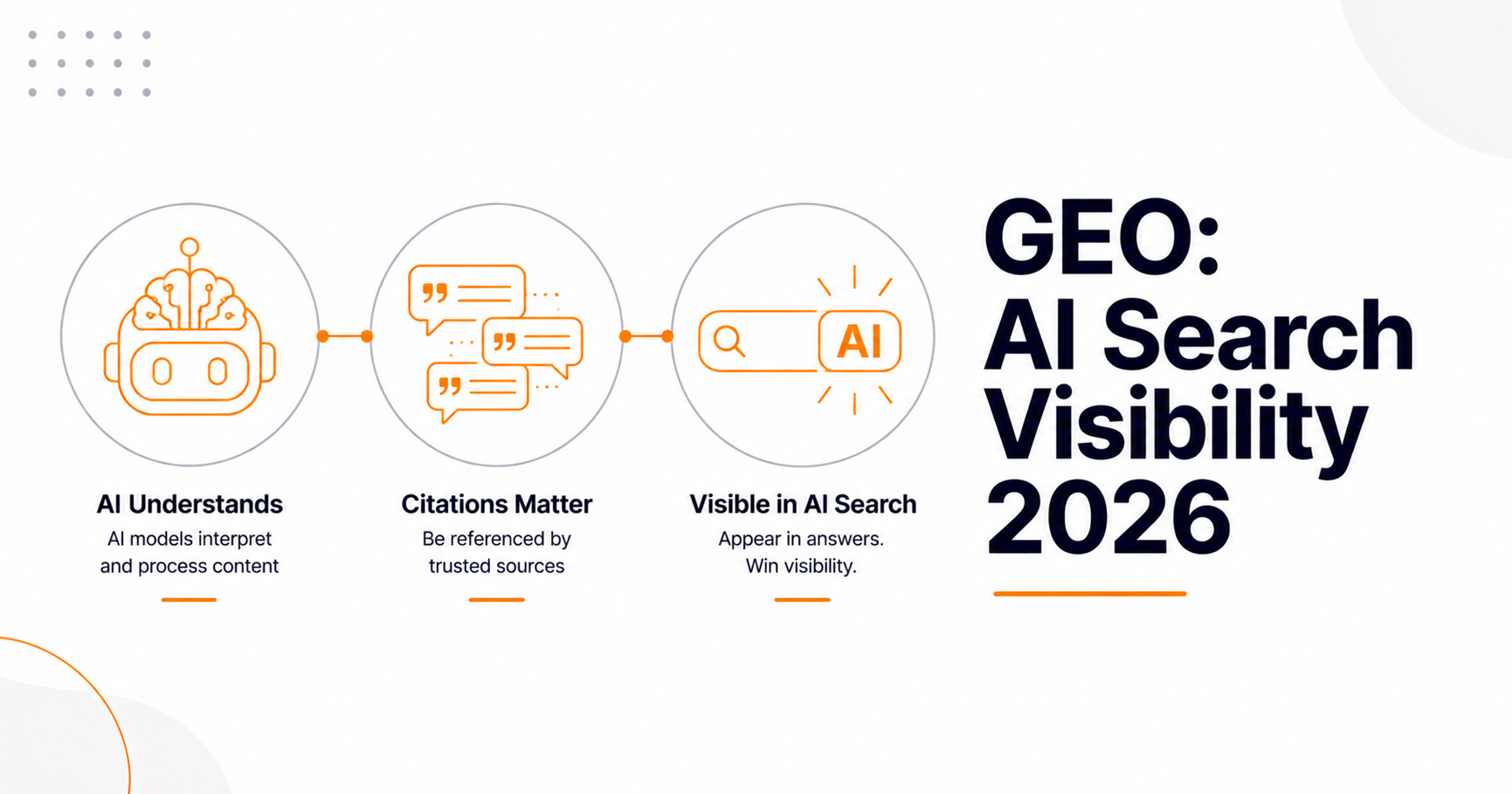
Generative Engine Optimization: 2026 GEO Guide

Generative Engine Optimization (GEO): The Complete 2026 Guide to AI Search Visibility
Search has changed fast. In 2024, 56% of news-related Google searches ended with no click to any website, and by 2025 that figure had climbed to 69%, a 13-percentage-point leap in one year. And in 2026, over 60% of all Google searches are now zero-click events across every category. Users get the answer straight from an AI-generated summary, so they never visit your page.
Is your SEO strategy still built around ranking for clicks? Then you are chasing a shrinking pool, because SEO built that traffic over a decade and AI answers are now soaking it up, whether that is Google AI Overviews, ChatGPT, Perplexity, Gemini, or Claude. This is not a short blip but a deep shift in how people find and use facts online.
Welcome to the era of Generative Engine Optimization (GEO), the biggest new field in digital marketing since SEO itself.
What Is Generative Engine Optimization (GEO)?
Generative Engine Optimization is how you shape, write, and improve your content for AI. The goal is simple: you want AI-powered search systems to cite your pages as a source when they build answers for users.
Traditional SEO was about earning a spot in the blue-link results, while GEO is about earning a spot inside the answer itself. You want the AI to quote you, cite you, sum up your point, or send people your way, and all of that happens before the user thinks about clicking at all.
The term sits close to two others you have likely seen:
- AEO (Answer Engine Optimization) — tuning your pages for direct answer boxes and voice search replies.
- LLM Optimization / AI Visibility — making sure language models hold correct, positive facts about your brand.
GEO is the umbrella that covers all three. It takes in citation authority, share of model, sentiment management, and narrative control across the full AI ecosystem.
Why GEO Matters More Than Ever in 2026
The numbers are striking. ChatGPT crossed 900 million weekly active users in February 2026, and Perplexity handles hundreds of millions of queries each month. Google's AI Overviews now show up on a large share of search results pages, above all for informational queries. Apple is building AI answers into Siri, with Safari and Spotlight flagged as later surfaces. Microsoft's Copilot answers Bing queries with AI-written text.
Meanwhile, research from Ahrefs found something fascinating. AI search drove only 0.5% of their site visitors, yet it accounted for 12.1% of signups, and Ahrefs put that at a 23x higher conversion rate than traditional organic search. Seer Interactive ran a separate check on one B2B software client, where ChatGPT visitors converted near 15.9% and Perplexity visitors converted near 10.5%, against Google organic at 1.76%. Treat that second set as a single case study, not an industry benchmark.
The volume is lower, but the quality is sharply higher. Brands that appear inside AI answers get warm, pre-sold leads, because the AI has already vouched for them.
So you cannot ignore GEO, and that holds even when your traditional traffic numbers look flat.
How AI Search Engines Actually Work (The RAG Model)
First you need to grasp how AI search finds and builds content. Then you can optimize for it. Most AI search engines use a method called Retrieval-Augmented Generation (RAG), and that group includes Google's AI Overviews, Perplexity, and ChatGPT with web search.
Here is how it works in practice:
- A user types a query.
- The AI system pulls relevant content from its indexed sources, which include websites, databases, and trusted outlets.
- A language model reads it and blends that content into one clear answer.
- Citations get added to show where the facts came from.
Your page must pass two tests to make the cut. First it must be retrievable, which means indexed, crawlable, and clean on the tech side, and second it must be extractable, which means clearly written, well ordered, and grounded in facts. Fail either test and the AI skips you, even when your content is great.
Retrievability is where most pages quietly fail, because one stray rule can block a whole section. So review robots.txt, meta robots and noindex first. Then confirm Google picked the URL you meant, and our guide to canonical tags and duplicate content covers that step. Want to see what the crawlers really fetched, rather than what you assume? Then read log file analysis and crawl budget work, which shows you hour by hour.
So GEO and traditional SEO do not compete, because they are tied together at the root. Strong technical SEO is the base that GEO builds on.
The 7 Core GEO Strategies for 2026
1. Lead With the Direct Answer
AI systems are built to pull the best answer to a query fast. What happens if your content buries the lead and spends three paragraphs on background before stating the answer? The AI will either skip to a rival page or miss your key point entirely.
Build every page so the main answer lands in the first 100–150 words. Use your H1 to frame the question, and answer it right below. This is the single biggest structural fix you can make for GEO.
Work your target term into that opening block in a natural way. Use it once in the first sentence or two, and then let it go. Stuffing the same phrase through the intro reads as a trick, and it reads that way to classifiers and to humans alike. It also kills the clarity that makes a passage easy for a model to lift.
2. Back Every Claim With Sourced Data
Research steadily shows one thing: AI systems cite data-backed content more often than opinion writing. When you state a fact, link to the source, and when you cite a statistic, name the group behind it and include the year as well.
This does two things. First, it tells AI crawlers your content is grounded in facts, which is a major trust signal. Second, it creates the kind of checkable, citable text that language models are trained to prefer over claims no one can check.
3. Implement Structured Data (Schema Markup)
Schema markup in JSON-LD is one of the most direct tech signals you can send to AI systems. It removes doubt. It tells the AI what your page is about, who wrote it, what it holds, and how it links to other entities.
These schema types matter most for GEO in 2026:
- Article schema — sets your authorship and content type.
- FAQ schema — lets AI systems lift Q&A pairs straight off the page.
- Organization schema — confirms your brand entity.
- HowTo schema — best for how-to guides.
- Product schema — for pricing, reviews, and feature comparisons.
Check your JSON-LD before you ship it, because crawlers pass over broken markup silently. Search Console does flag markup it could not parse at all, so look in its unparsable structured data report. Clean, error-free schema is a must.
4. Build Topical Authority Through Content Clusters
AI models do not just judge single pages. They judge the depth and trust of your site's coverage on a topic. Say a site holds 40 high-quality, interlinked articles on SEO. That site signals far more authority than a site with one great SEO post among unrelated content.
Build content clusters. Start with one broad pillar page and back it with several smaller articles that cover subtopics. Each of those should link back to the pillar, and the pillar should link out to each of them. This internal linking helps traditional search engines and AI systems alike, because both can then see how your coverage is ordered and how complete it is.
Study your own content structure before you write anything new, because the usual problem is not a missing page but two pages that already fight over one intent. Our guide to keyword cannibalization and page overlap shows how to spot that, and which page to keep.
5. Establish and Signal E-E-A-T
Google's E-E-A-T framework covers Experience, Expertise, Authoritativeness, Trustworthiness. It is no longer just an editorial rule, because it now works as a technical signal that shapes AI content retrieval. In 2026, E-E-A-T is technical as well as editorial.
Practical E-E-A-T signals for GEO:
- Author bio pages with clear credentials, links to work profiles, and byline schema.
- Consistent brand entity mentions across high-authority external sites.
- Up-to-date content with real updates, not just a changed date but revised facts, examples, and links.
- Clear editorial policies and review steps.
- HTTPS, fast page load, and no broken links are all technical trust signals, and our guide to how HTTP status codes shape SEO explains which codes cost you what.
One warning on authority signals. Do not assume a rival is winning on E-E-A-T. Check what they really hold in the results you care about. Competitor analysis is cheaper than guessing.
6. Optimize for the 3-Month Citation Freshness Cliff
Data from GEO analytics tools reveals a "3-month citation cliff" pattern, where content that has seen no real update in over 90 days tends to lose AI citations fast. AI systems favor fresh, current facts, and that goes double for the ones using live web retrieval.
This does not mean you rewrite every post every three months. It means you make real updates. Refresh statistics with the latest figures, add new examples, point internal links at newer content, and revise FAQs so they match the questions people ask now. A real update resets the freshness signal, even a small one. Our guide to content refreshing, pruning, and content decay walks through how to choose what to update first.
7. Optimize Content Structure for Machine Extraction
AI bots parse your page in a different way from human readers, and a few structural choices sharply raise the odds that your content gets pulled and cited:
- Use clear H2 and H3 headings, where each one works as a question or a plain statement on its own.
- Write short, tight paragraphs, and cap key explanatory blocks at 2–4 sentences.
- Use numbered and bulleted lists for steps, comparisons, and any set of items.
- Do not hide content behind JavaScript interactions, accordions, or tabs, because AI bots cannot click.
- Add a well-built FAQ section near the end of every major article.
- Add a clear summary or TL;DR near the top for pages that target informational queries.
Do this pass by hand. Read your own headings in order, check that every page carries a real title and description, then strip the styling and confirm the structure still makes sense. Those are the parts a model must parse before it can quote you. If the list of faults grows past a handful, escalate it with a technical SEO audit your developers will act on.
GEO vs. Traditional SEO: What Changes, What Stays
| Dimension | Traditional SEO | GEO |
|---|---|---|
| Primary goal | Rank in blue-link results | Be cited inside AI answers |
| Key metric | Organic clicks & rankings | Share of Model, brand citation rate, AI referral traffic |
| Content style | Keyword-rich, long-form | Answer-first, structured, data-backed |
| Technical requirements | Core Web Vitals, indexability | Same + schema markup, entity validation |
| Link building | Backlinks for PageRank | Brand mentions + backlinks for entity authority |
| Freshness | Helpful but not critical | Critical — 3-month citation cliff is real |
GEO does not replace SEO. It extends it, and traditional SEO signals such as technical health, backlinks, and quality content are the base. GEO adds structure, entity validation, and AI-specific signals on top.
Measuring GEO Performance: Beyond Google Analytics
The hardest part of GEO is measurement, because most AI-driven discovery is zero-click. Your brand shows up in an answer and earns trust. The user then searches your brand name later, or they arrive as a direct visit. Traditional Google Analytics does not catch that influence.
This is also why AI search gets blamed for falls it had no part in. Do not pin a decline on an AI answer too soon. Rule out the cheaper causes first, in base-rate order, and our guide to finding the real cause of an organic traffic drop walks that path. Tracking faults and reporting artifacts are far more common than any algorithmic cause.
The metrics GEO practitioners track in 2026:
- Share of Model (SoM) — how often your brand shows up when users query AI tools about your field.
- AI Overview appearances — you can track these in Google Search Console for some query types.
- Branded search volume — an indirect signal that AI citation is lifting awareness.
- AI referral traffic — visits that arrive from an AI tool such as ChatGPT or Perplexity. Since May 2026, GA4 files these under their own AI Assistant default channel group, and it no longer lumps them in with plain referrals. Hold two limits in mind. A true zero-click citation sends no visit at all, so it never reaches this report, and a click that lands with its referrer stripped drops out of that channel, showing up under Direct when it carries no campaign tag, or under Unassigned when it carries a source tag with no medium.
- Citation tracking — manual or tool-assisted checks on which pages the major AI tools cite.
Pair these AI-specific metrics with your current authority reporting. That gives you the full picture, both traditional and AI-facing. If your measurement layer cannot yet split one channel from another, build that layer first with first-party data for SEO measurement, and read the report mechanics in our practitioner's guide to Search Console.
Common GEO Mistakes to Avoid
- Treating GEO and SEO as separate strategies — they compound each other, because AI models use live web search to find sources.
- Mass-producing AI-generated content — thin AI copy harms your traditional rankings and your AI citation rates too.
- Only optimizing your own site — AI learns about your brand from third-party sources too, so you need a presence on trusted outside platforms.
- Hiding content behind interactions — tabs, accordions, and sliders that need clicks are invisible to AI crawlers, and the same goes for content that only exists after a script runs. See how Google renders JavaScript and why pages vanish.
- Ignoring page speed — slow pages make it harder for AI bots to reach your content, so confirm you still pass LCP, INP and CLS.
- Measuring only clicks — zero-click AI citations still build influence even when no visit happens.
Platform-Specific GEO Tips for 2026
Google AI Overviews
Google's AI Overviews favor content that already ranks well in organic results. Strong E-E-A-T signals help, as does structured data markup. Focus on FAQ schema and strong topical authority, then look at pages that sit on page one now for their target keywords, because those are the most likely to surface in Overviews.
ChatGPT (Web Search Mode)
ChatGPT's web-search citations lean hard toward clear source attribution, and they also want factual precision and recent update dates. Technical articles do well here, and so do research-backed guides and original data studies.
Perplexity AI
Perplexity is citation-first by design, so it leans toward pages with strong domain authority and clear authorship signals. It also wants content laid out so a machine can quote it straight. Get listed in industry-standard directories and earn editorial coverage on trusted sites. Both steps lift your Perplexity citation rate sharply.
Apple Intelligence & Safari Search
Apple is moving AI answers into Siri, with Safari flagged as a later surface. So brand mentions and structured data now matter even more on mobile. Make sure your Organization schema, Contact schema, and local SEO signals are correct, and keep them the same across all your major web properties.
The Bottom Line: Invest in GEO Now
AI search use will keep growing. Google is expanding AI Overviews, ChatGPT is adding shopping tools, and Apple Intelligence is deepening its web access. Agentic AI systems are moving from experiments to the mainstream. Those systems browse the web, compare options, and complete purchases for users.
The brands that invest in GEO now are building a big head start. The playbook is still being written in real time, but the core rules are clear. Lead with answers, back claims with data, keep your technical base clean, build topical authority, and refresh content often.
Zero-click does not mean zero opportunity. It means the chance has moved off the results page and into the answer itself. GEO is how you claim it.
Frequently Asked Questions About GEO
What is the difference between GEO and SEO?
SEO (Search Engine Optimization) aims to earn rankings in traditional blue-link search results. The goal there is clicks to your website. GEO (Generative Engine Optimization) aims to get your content cited inside AI-generated answers built by tools like Google AI Overviews, ChatGPT, and Perplexity, where users often read the answer and never click at all.
Does GEO replace SEO in 2026?
No. GEO builds on top of SEO, it does not replace it, and technical site health, content quality, backlinks, and E-E-A-T signals are the foundation for both. AI models use live web search to find sources, so strong traditional SEO feeds GEO results directly.
How do I know if my content is being cited by AI tools?
You can check by hand, searching for your brand or key topics in ChatGPT, Perplexity, and Google's AI Overviews. GEO tracking tools from Ahrefs, Semrush, and niche GEO platforms are also emerging to automate citation checks. Rising branded search volume in Google Search Console is another indirect sign.
What type of content gets cited most by AI systems?
Data-backed content with sourced statistics tends to win, and so does clear answer-first writing. FAQ sections with schema markup tend to help, and so do original research and unique insight. Content from sites with strong domain authority and clear authorship signals also tends to earn higher AI citation rates.
How often should I update content for GEO?
Review high-priority pages every 90 days at the least. Refresh statistics, update examples, revise internal links, and make sure your FAQs match what users ask now. Real updates reset freshness signals while changed dates alone do not. Steady updates help you keep steady AI citation rates.