The 10 Best Link-Building Tools in 2026 (Tested & Compared)

Here is the pattern that burns the most budget in link work. A small team subscribes to three platforms in a single week, the bill clears $600 a month, and ninety days later they hold four new links, two of which came from directories. Nobody misused the software, because the genuine mistake was purchasing parts instead of building a process.
That is why most roundups fail you, because they rank products, and your campaign does not actually run on products. It runs on three jobs performed in order, which are finding the link, finding the person, and landing the reply. Neglect one of those jobs and the other two immediately stop paying rent.
So this guide organizes the best link building tools by the job they do, and you get honest strengths, real weak spots, and prices we verified against each vendor page on 8 September 2026. Three vendors would not let us read their page that day, so we name all three and quote no number for any of them. Old figures never get carried forward here.
What changed in link building since 2024?
Three things changed, because topical relevance now outweighs raw domain scores, and AI answer engines cite their sources, so one good link can turn into a mention inside ChatGPT, Gemini, or Perplexity. Vendor pricing also moved hard, with the big suites splitting into cheaper, narrower plans that look nothing like their 2024 line-up.
The domain score chase remains the oldest bad habit in this industry, because a powerful site in the wrong topic delivers very little for you now, while a mid-sized site in your exact niche frequently delivers considerably more. That is the same logic behind topical authority and content clusters, and it completely changes how you qualify a prospect.
The second shift is considerably bigger, because answer engines select sources to quote, and links and citations directly feed that selection. Pursue links that a writer or an editor would cite by hand, and you satisfy both systems simultaneously. We go deeper on that in our guide to getting cited by ChatGPT, Perplexity, and Gemini.
The third shift hits your credit card, because prices in this category age badly and half the figures on competing roundups are two years stale. That is not a trivial error, since it changes which stack a small team can genuinely afford, and it means the link building tools you shortlisted in 2024 may no longer be the sensible purchase today.
How do the best link building tools split into three layers?
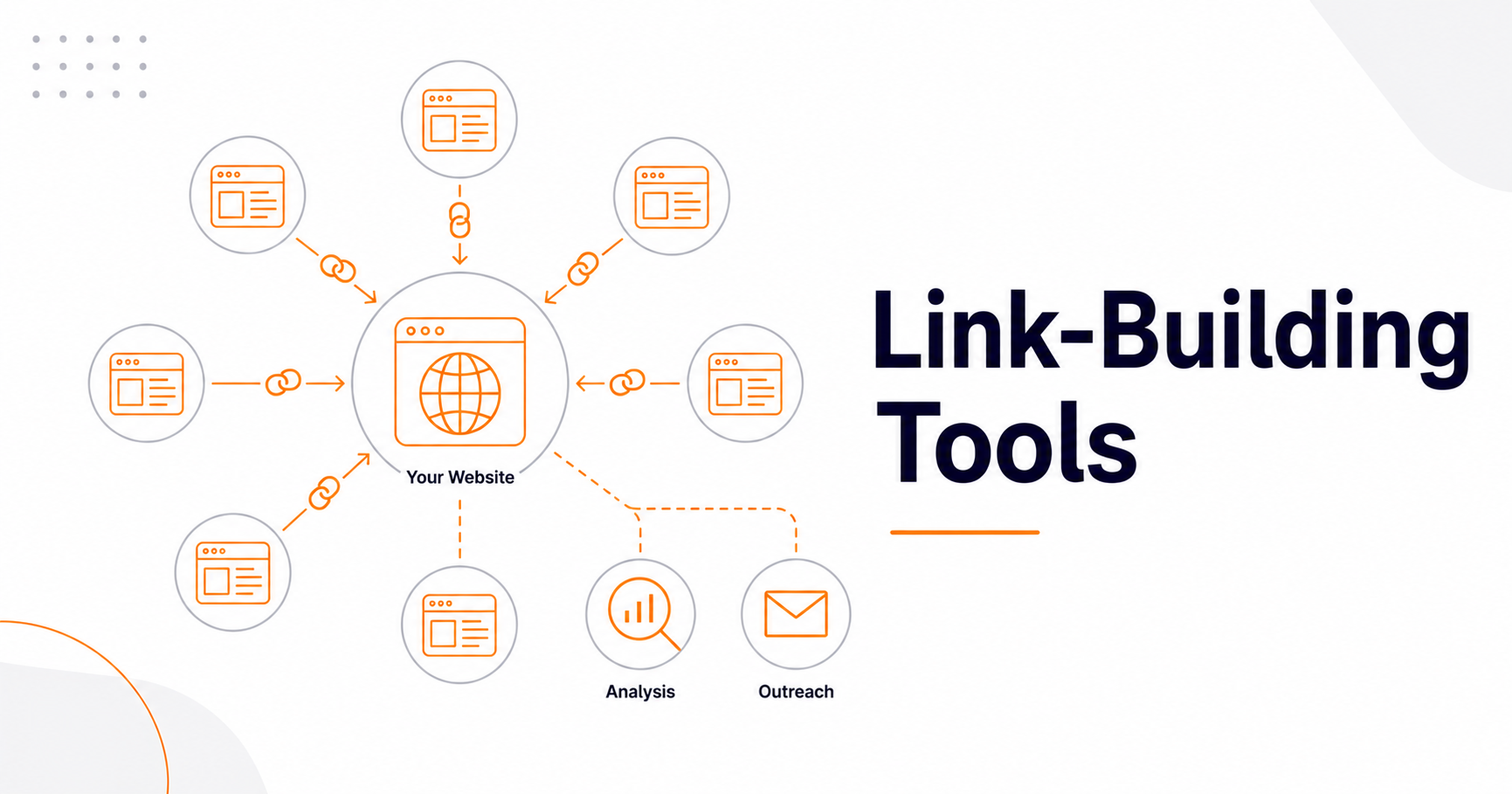
They separate into analysis, prospecting, and outreach, where analysis maps the link graph and evaluates a target, and prospecting locates the sites plus the human contact. Outreach then manages the pitch, the follow-up, and the permanent record of who said what. Most link building tools handle one of those layers well and the other two badly.
Read the table with that structure in mind, because the right question is never which product is objectively best, it is which layer is your bottleneck this quarter.
| Tool | Layer | Best for | Price checked 8 Sept 2026 |
|---|---|---|---|
| Ahrefs | Analysis | Freshest backlink index | Lite $129 a month, Starter $29 |
| Semrush | Analysis | All-in-one plus AI visibility | SEO plan $139 a month, near $117 annual |
| Majestic | Analysis | Judging link quality | Lite $49.99 a month |
| Moz Pro | Analysis | Beginners and small teams | Their page would not load for us, so no figure |
| BuzzSumo | Prospecting | Digital PR and content links | From $199 a month |
| Hunter.io | Prospecting | Finding and checking emails | $49 a month, or $34 on annual billing |
| Mangools LinkMiner | Prospecting | Small budget prospecting | Their page refused our connection, so no figure |
| Pitchbox | Outreach | Automation at scale | Pro $300 a month, or $210 annual |
| BuzzStream | Outreach | Tracking relationships | Public price page was down |
| Snov.io | Outreach | Simple email sequences | Budget tier |
Method: we opened each vendor's own pricing page on 8 September 2026 and quoted only what it showed. Mangools refused our connection twice. Moz blocked the fetch. BuzzStream returned a missing page. Rather than guess, we left those three blank. Confirm any figure yourself before you buy, because these move every quarter.
Which tools give you the best backlink data?
Ahrefs wins on freshness, Majestic wins on evaluating whether a link is worth pursuing, and Semrush wins if you want a single login for links, keywords, audits, and AI visibility. Moz Pro remains the gentlest landing for a beginner, so choose one of those four platforms rather than two.
Ahrefs, for speed and depth
Ahrefs operates one of the busiest crawlers on the web, so newly created and recently lost links appear quickly, frequently on the same day. Most link building tools refresh their index considerably more slowly, and that difference matters more than people think, because when a placement disappears from a client's profile you want to know this week rather than next month.
Site Explorer remains the cleanest way to extract a competitor's referring domains, although the Link Intersect view is the genuine workhorse. It identifies sites that link to two competitors but not to you, and those are consistently your warmest pitches.
Pros: fastest index, superb competitor forensics, clear reports. Cons: no open trial, and the Lite plan runs out of room quickly. Lite is $129 a month, and a new Starter tier at $29 a month now exists, which is a fair way to evaluate the data before you commit.
Semrush, for one login
Semrush gives you backlinks alongside keywords, audits, and rank tracking, and it also measures how frequently brands appear inside AI answers, which pairs neatly with our notes on generative engine optimization. Fewer open tabs consistently means faster work.
Their plans have been completely rebuilt since 2024. The entry SEO plan is $139 a month, or near $117 a month on annual billing. The Starter tier is $199 a month, or near $165 annually.
Pros: true all-in-one, strong client reporting, AI visibility built in. Cons: link freshness trails Ahrefs by a step, and the cheapest tier restricts intensive link work.
Majestic, for quality calls
Majestic performs exactly one job, and its historic link index reaches back to 2006, where Trust Flow evaluates link quality and Citation Flow measures raw volume. Topical Trust Flow tells you what a site is genuinely about, which is the single most useful number available when you qualify a prospect.
Here is the trick most teams miss, because a site with high Citation Flow and low Trust Flow carries plenty of links from junk, and you should skip it entirely. That single ratio saves hours, and Lite is $49.99 a month, or $41.67 a month if you pay for the year. Their prices exclude VAT, so European buyers pay more.
Pros: deep history, honest quality signals, affordable. Cons: no keyword or content capability whatsoever.
Moz Pro, for a soft start
Moz gave the industry Domain Authority and Page Authority, and both remain the shorthand a client immediately understands on a call. The interface is genuinely kind to newcomers, and the learning material is excellent.
We could not load their pricing page on the day we checked, so we quote no figure at all. Read the current plans on their site before you buy.
Pros: gentle learning curve, familiar metrics, good training. Cons: noticeably weaker for large scale prospect mining than Ahrefs or Majestic.
Which tools find the sites and the people?
BuzzSumo locates the story and the journalist, Hunter.io locates the inbox, and Mangools LinkMiner assembles a shortlist on a modest budget. This layer is where campaigns quietly stall, because a prospect with no named contact is not genuinely a prospect at all.
BuzzSumo, for digital PR
BuzzSumo is not a backlink database, so treat it instead as a demand radar that reveals which angles get shared, which writers cover your topic, and which formats consistently earn coverage. Use it to plan the asset, and then pitch that asset properly.
Pricing starts at $199 a month for the Content Creation plan, with PR tiers above that. It is the most expensive prospecting option here, and it only pays back if you publish original data or expert commentary, because no radar will rescue generic content. Our note on how long a page should be is a useful sanity check before you build the asset.
Hunter.io, for contacts
Hunter.io converts a domain into a real email address and then verifies that the address actually works, and that second step is where the genuine value sits. A clean list protects your sending domain, while a dirty list incinerates that reputation within a week.
List price is $49 a month. Annual billing drops it to $34 a month. There is a free tier for light usage, and it is genuinely sufficient for a first campaign.
Mangools LinkMiner, for lean teams
Mangools LinkMiner sits inside a friendly suite that freelancers appreciate, and although its coverage is thinner than Ahrefs, twenty pitches a month makes thinner perfectly acceptable. Their site refused our connection twice on 8 September, so we quote no price. It has long been one of the cheapest paid options in this category.
Which tools keep outreach from falling apart?
Pitchbox automates volume, BuzzStream remembers people, and Snov.io handles simple sequences cheaply. The classic failure is never a weak pitch, it is forgetting who replied, who declined, and whose follow-up is nine days overdue.
Pitchbox
Pitchbox is built for agencies running hundreds of simultaneous threads, and it connects to the major link databases, builds personalized sequences, and chases follow-ups automatically. Pricing is public now, and Pro is $300 a month, or $210 a month on annual billing. Higher tiers run to $600 and $1,200, so if you saw $550 quoted as the entry price, that figure is out of date.
Cons: genuine overkill under roughly fifty live threads.
BuzzStream
BuzzStream is a relationship layer rather than a data layer, so build the list inside Ahrefs or Majestic and then run the humans through BuzzStream. Editors get remembered across campaigns, which is precisely how you earn the second and third link from a single contact. Their public pricing page returned a missing page for us, so ask them directly.
Snov.io
Snov.io combines contact discovery with sequencing at a low price, which suits a deliberately simple stack where you find sites in one platform, qualify them by hand, and then load the list here. Data depth is lighter than the premium alternatives, and deliverability needs consistent watching.
What can free link building tools actually do?
More than most people expect, because Google Search Console displays your profile exactly the way Google sees it, and Ahrefs Webmaster Tools opens paid-grade data for your own domain. Search operators uncover resource pages for nothing, and HARO, now run by Featured, still lands editorial links if you answer quickly.
Some of the most useful link building tools cost nothing at all, and Search Console is the one that settles arguments, because it presents Google's own view rather than a vendor's estimate. Use it to identify valuable links that disappeared after a redesign.
Search operators still work, so request pages that list resources in your niche and then check which of their outbound links are dead. A dead link paired with a better replacement is the highest reply-rate pitch available anywhere. Before you approach anyone, it is worth learning how to check whether a site is blacklisted, because one bad neighbour can undo a quarter of clean work.
Podcasts belong on this list too, because a guest appearance usually earns a show-notes link plus a genuinely relevant audience. Our podcast SEO guide covers how to pitch one.
How do you build a stack instead of a pile of subscriptions?
Start with your bottleneck, because if you cannot evaluate a prospect you buy analysis, if you have a list and no names you buy prospecting, and if threads go cold you buy outreach. Purchase link building tools in that order, one layer at a time, and only when the previous layer is completely used.
A lean stack looks like this: Majestic for evaluating quality, Hunter.io for contacts, and a spreadsheet for tracking. That combination costs under $100 a month and it genuinely works, so do not laugh at the spreadsheet, because under thirty live threads it comfortably beats software you have not learned yet.
An agency stack looks considerably different, combining Ahrefs plus Semrush for data, BuzzSumo for angles, and Pitchbox for volume. That is real money, so it demands real throughput to earn out.
Whatever you select, the target pages matter considerably more than the software, so send links to pages that already convert and already read well. Run them past our on-page SEO checklist first, and then map them into pillar pages and content clusters so the earned authority spreads instead of pooling on a single URL.
What does a link building stack cost per month?
Plan on roughly $80 for a solo operator, $250 to $450 for a small team, and $700 or more for an agency. A full set of link building tools can cost $80 a month or $1,500, and the gap is throughput, not quality.
| Team | Typical stack | Rough monthly cost |
|---|---|---|
| Solo | Majestic Lite plus Hunter.io annual | About $84 |
| Small team | Ahrefs Lite plus Hunter.io plus a tracker | About $180 to $250 |
| Agency | Ahrefs plus Semrush plus Pitchbox Pro | About $550 to $700 |
| Enterprise | Above plus BuzzSumo PR tiers | $1,000 and up |
Those totals use only the figures we could verify, so treat them as a shape rather than a quotation. One honest test of value is remarkably simple, because you divide your monthly tool spend by the links you earned last quarter, and if a single link costs more than a freelance article, your bottleneck is content rather than software. You can also compare these platforms and their competitors in our software directory.
How does outreach change across the USA, Europe, and South Korea?
The pitch stays the same, but the law and the language definitely do not, because US senders follow CAN-SPAM, while European senders answer to GDPR and national rules that treat cold email considerably more strictly. Korean outreach often needs Korean, because Naver holds genuine market share there.
In Europe you maintain a lawful basis under GDPR, keep records, and honour opt-outs on the first request. National ePrivacy rules sit on top of that, and several member states expect prior consent even for business email. Consult a lawyer before you scale, rather than afterwards.
Korea deserves its own paragraph, because most link building tools index the Latin web well and the Korean web poorly, and Naver blogs, cafes, and news sites rarely appear inside a standard prospect export. If Korea matters to you, build that list by hand and pitch in Korean. Budget in won, since a $129 plan lands near 170,000 to 180,000 won depending on the rate that week.
One more regional note is that reply rates across the EU run lower and slower than in the US, and August is effectively dead throughout most of the continent. Plan your campaigns around that reality.
What mistakes kill link campaigns fastest?
Buying volume, chasing scores, mailing dirty lists, and pitching a page nobody wants to cite. Three of those four are cheap to fix this week.
Volume is the worst offender, because a hundred generic emails earn fewer links than ten researched ones, and they cost you the domain reputation you will need later. Cut the list, and raise the effort accordingly.
Score chasing comes next, because Domain Rating and Domain Authority are vendor estimates rather than Google outputs. Use them to sort a list, never to decide, and read Topical Trust Flow and the site's real organic traffic beside them.
The fourth mistake is the hardest to admit, because no stack of link building tools fixes a page that nobody wants to cite. Build something genuinely worth a link first, whether that is a survey, a calculator, or a fresh data cut, and then pitch it.
How do links feed AI search in 2026?
Answer engines select sources, and links remain one of the strongest signals of which sources deserve that selection. Earn citations from sites that already get quoted, and you inherit a portion of their standing.
This is the biggest change since the previous edition of this guide, because a link used to be purely a ranking input, and it now doubles as a shortlist ticket for answer surfaces. Our breakdowns of Google AI Mode and how AEO, GEO, and SEO differ explain the mechanics.
Trust is the through line here, because real authors, real credentials, and real sources all improve your odds, which is exactly the ground covered in E-E-A-T and building trust with Google and AI. Rankings alone no longer tell you whether it worked, so learn to track AI referral traffic in GA4 and read that beside your link count.
Two more pieces round this out, so match your target pages to genuine search intent and micro-intents, and plan for the reality that many queries end without a click at all. Our guide to zero-click search covers how to win those anyway. If your traffic moved this spring, check it against the May 2026 core update before you blame your links.
Want your tool featured here?
We update this guide as the market moves, and it moves remarkably quickly. If you build or use an outreach or backlink product that deserves a place, tell us what makes it different, and send the details through the contact page on this site so we can consider it for the next revision. Working pricing pages help your case considerably.
Frequently asked questions
What is the best link building tool in 2026?
There is no single winner, and anyone who confidently names one is selling something. Ahrefs leads on index freshness, Majestic leads on evaluating link quality, and Semrush leads if you want one login for everything, so most strong setups pair one analysis product with one outreach product. Start from the job you cannot do today.
Do you need paid software to build links?
Not at first, because Google Search Console, Ahrefs Webmaster Tools, search operators, and HARO will comfortably carry a first campaign. Paid plans start earning their keep when you run more than roughly twenty pitches a month, or when you need competitor data you cannot see for free. Buy the first plan only after the free route genuinely stalls.
Which metrics should judge a backlink?
Use three metrics, never one, so Topical Trust Flow tells you what the site is about, Trust Flow against Citation Flow tells you whether its own links are clean, and real organic traffic tells you whether anyone actually visits. Domain Rating and Domain Authority remain useful for sorting a list, but they are vendor estimates rather than Google numbers.
How many products should a small team run?
Two or three, meaning one for analysis, one for finding contacts, and one for tracking threads. Teams waste more money on unused seats than on the wrong product, so add the third only when your tracking method visibly breaks, and remember a spreadsheet is a perfectly good outreach tracker under about thirty live conversations.
Is Ahrefs or Semrush better for backlinks?
Ahrefs, if links are the only job, because its crawler is faster and lost links surface sooner. Semrush wins when you want backlinks beside keyword research, audits, and AI visibility in one place, and on price the two land close. Ahrefs Lite is $129 a month, and the Semrush SEO plan is $139, with both cheaper on annual billing.
How much should a small team budget each month?
Between $180 and $250 covers a serious two-layer stack, which is roughly one strong analysis plan plus an email finder. Agencies land nearer $550 to $700 once outreach automation joins. Check each vendor page before you commit, because these numbers have shifted every few months for the last two years.
Is cold outreach email legal in Europe?
It is regulated rather than banned, and GDPR requires a lawful basis, honest sender details, and a working opt-out. Several member states apply stricter national rules to unsolicited business email, while US senders have an easier ride under CAN-SPAM. Get professional advice before you scale a European list, and keep your records tidy from day one.
Should AI write your outreach emails?
Use it for the first draft and the research summary, never for the final send. Editors spot template language instantly, and a generic pitch burns a contact permanently, so the winning move is a two-line personal opener that proves you read their page, followed by a clear and short request. Machines remain genuinely bad at the opener.
How long until new links move rankings?
Expect four to twelve weeks before a pattern appears, and considerably longer in competitive niches. A single link rarely moves anything on its own, because consistently earned links into one topic cluster over a quarter is what actually shifts positions. Track links earned and referral clicks monthly, and judge rankings on a rolling three-month view.
Do broken-link and guest-post tactics still work?
Broken-link building works well, because you offer a repair rather than a favour. Guest posting still works when the site has a real audience and real editorial standards, although paid networks and mass-published guest posts definitely do not. If a site accepts anything for money, its links are worth roughly what you would expect.
Final thoughts
Go back to the team from the opening, with three subscriptions, $600 a month, and four links. The fix in that situation is never a fourth product. It is cutting back to one analysis plan, one email finder, and a real asset worth citing, and that stack costs under $200 while comfortably beating the pile.
The best link building tools in 2026 are the three that match your bottleneck, and no more than that. Choose one for analysis, choose one for contacts, and track the humans somewhere reliable. Then spend the remainder of the budget on something worth linking to, because software has never earned a link on its own.
Our prediction for the coming year is simple, because vendor pricing keeps splitting into narrower tiers, and citation tracking becomes a standard feature rather than an expensive add-on. Teams that measure mentions beside links will read the market first.
So which layer is actually holding you back right now, the data, the contacts, or the follow-up?