Content Clusters and Pillar Pages Guide 2026

Content Clusters and Pillar Pages: How to Build Topic Authority That Ranks in Google and Gets Cited by AI
Search engines and AI systems agree on one thing in 2026: isolated content does not build authority. A single brilliant blog post, no matter how well-written or heavily promoted, cannot establish the kind of topical credibility that makes Google rank you consistently across an entire subject — or that makes ChatGPT and Perplexity cite your brand as a trusted source.
What builds that authority is content clusters — interconnected networks of articles that cover a topic with the depth and breadth that signals genuine expertise. Combined with a comprehensive pillar page as the authoritative hub, content clusters are the single most impactful structural investment any content programme can make in 2026.
This guide walks through exactly how to build them: how to plan your cluster architecture, write pillar pages that earn rankings, develop cluster articles that compound authority, and connect everything with internal linking that both search engines and AI retrieval systems can follow.
Why Content Clusters Work: The Authority Signal Explained
To understand why clusters work, you need to understand what modern search algorithms are actually evaluating.
Google's ranking systems — including the Helpful Content system and PageRank — have increasingly moved away from evaluating individual pages in isolation. Instead, they evaluate a site's authority on a topic domain as a whole. The question is no longer just "is this page good?" — it is "does this site comprehensively and credibly cover this subject?"
A site with 25 well-written, interconnected articles on personal finance will rank more consistently across personal finance queries than a site with one award-winning personal finance guide, because the former demonstrates systematic expertise while the latter demonstrates a single moment of quality.
AI systems like ChatGPT, Perplexity, and Google's AI Overviews apply similar logic. They do not just evaluate individual pages — they evaluate topical credibility across a domain. Research shows that content clusters covering a topic comprehensively signal the kind of expertise that AI models treat as citation-worthy. When your site becomes a recognised authority on a topic, AI systems preferentially cite your pages across queries related to that topic — even queries for which you do not have a specific article, because the model has learned that your domain is a reliable source on the subject.
This is the compounding effect of topical authority: early investment in cluster depth produces disproportionate returns as authority accumulates over time.
The Anatomy of a Content Cluster
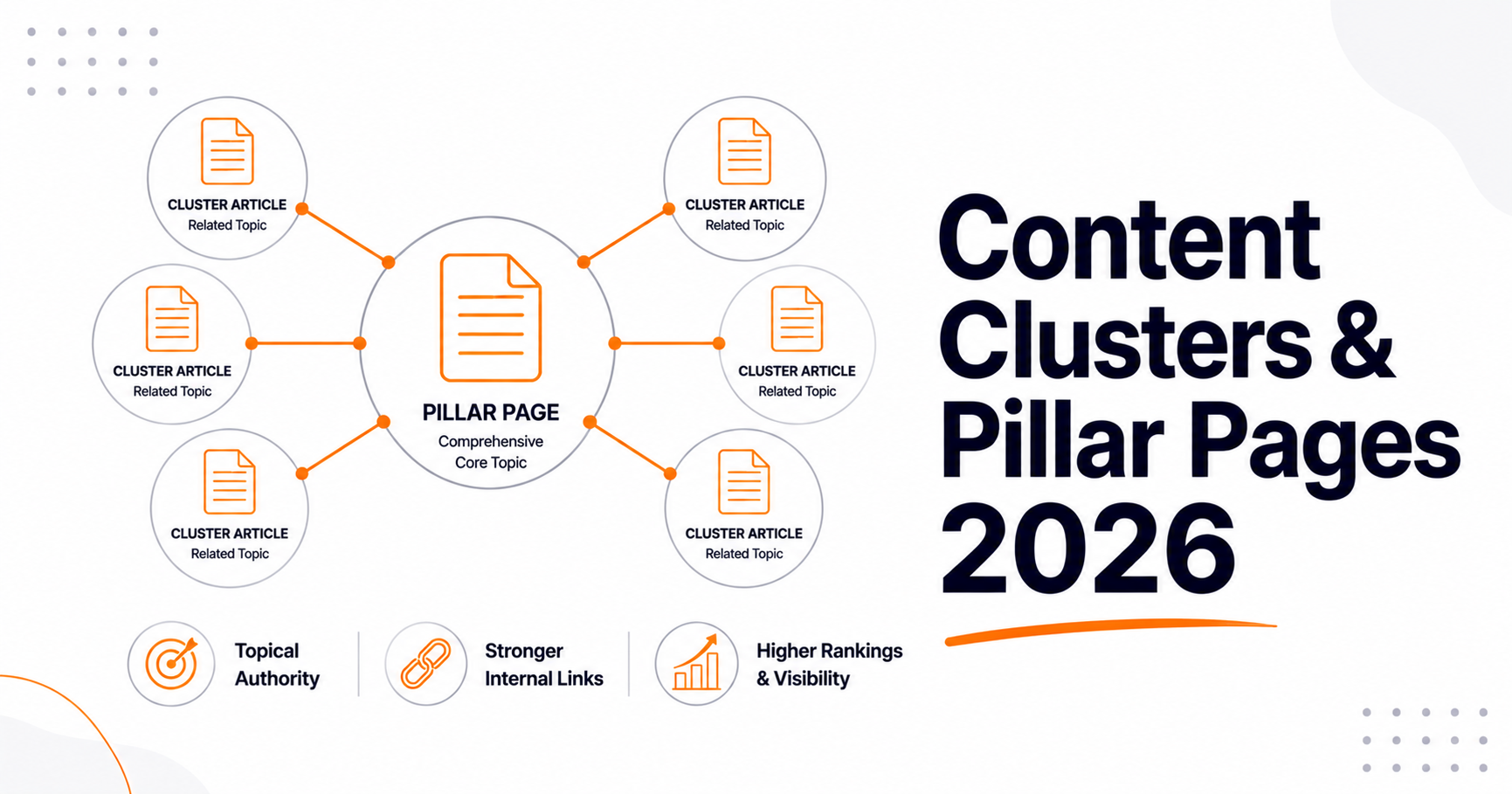
A content cluster has three structural components: the pillar page, the cluster articles, and the internal linking architecture that connects them.
Component 1: The Pillar Page
The pillar page is the anchor of the entire cluster. It covers the broad topic comprehensively at an overview level — addressing every major subtopic within the domain without going deep on any single one. Think of it as the definitive introduction to the subject, written for someone who wants to understand the full landscape before deciding which aspect to explore further.
Pillar pages in 2026 typically run 3,000–5,000 words. They target high-volume, broad head terms — the kind of keywords where the searcher intent is to learn about a topic category, not to find a specific answer. They link out to every cluster article in the network, signalling to search engines that this page is the authority hub for the topic.
Structurally, a pillar page should include: a comprehensive topic overview in the opening section, clearly organised H2 headings covering each major subtopic, brief but substantive treatment of each subtopic with links to the dedicated cluster article for deeper reading, a summary or key takeaways section, and a FAQ block targeting the most common questions about the topic as a whole.
Component 2: Cluster Articles
Cluster articles are the depth layer of the architecture. Each one covers a specific subtopic of the pillar in thorough, standalone detail — targeting a more specific long-tail keyword that the pillar page does not have the space to address fully.
A pillar page on "content marketing strategy" would have cluster articles covering: content repurposing systems, user-generated content, content distribution channels, how to build a content calendar, measuring content ROI, writing for AI citation, content cluster architecture (this very article), blogging for small businesses, and so on.
Every cluster article should be a genuinely valuable, standalone resource — not a thin placeholder that exists only to support the pillar. It should target a real search query that a real person would submit, and it should answer that query more thoroughly than any competitor in the niche.
Ensure each cluster article's on-page elements are fully optimised before publishing — use our free Meta Tag Analyzer to verify that meta titles, descriptions, and heading structure are clean and correctly configured across your cluster pages.
Component 3: The Internal Linking Architecture
Internal links are the connective tissue that makes a cluster function as a unified authority signal. Without proper internal linking, your pillar page and cluster articles are just a collection of individual posts — with links, they become a coherent topic network that communicates the topical relationship explicitly to search engines.
The linking rules for a well-built cluster are:
- Every cluster article links back to the pillar page, using the pillar's target keyword as anchor text
- The pillar page links out to every cluster article, using descriptive anchor text that signals what each cluster covers
- Cluster articles link to other relevant cluster articles within the same network (lateral links) where the content is genuinely related
- All internal links use canonical URLs — always
https://nasseotools.com/post/{slug}, never withwww
This bidirectional linking structure is what search engines follow to understand the topical hierarchy of your content. It is also what AI retrieval systems use to identify which pages belong to the same authority domain — making it critical for both SEO and GEO performance.
Step-by-Step: Building Your First Content Cluster
Step 1: Choose Your Anchor Topic
The anchor topic should meet three criteria. It should be a subject your brand has genuine expertise in — not a topic you are covering opportunistically. It should have sufficient search demand to justify the investment (a topic that generates queries across multiple subtopics, not a niche so narrow that only a handful of specific queries exist). And it should be commercially relevant — connected to what your brand actually does or sells, so that the authority you build has a direct path to business value.
Do not try to build more than 2–3 clusters simultaneously, especially in the early stages. Focus and depth beat breadth consistently. Three deeply developed clusters of 30–40 articles each will outperform ten shallow clusters of 5–8 articles each on every meaningful metric.
Step 2: Map the Topic Landscape
Before writing anything, map the full topic landscape. Start with your anchor topic and brainstorm every subtopic, question, use case, audience segment, and related concept within it. Use Google's People Also Ask and People Also Search boxes, review competitor content structures, analyse your existing content for what you have already covered, and query AI tools to identify what questions they receive most frequently on the topic.
The output of this mapping exercise is a topic inventory — a list of every potential cluster article. From this list, you will prioritise which articles to write first based on search volume, commercial relevance, and how well they support the pillar's authority claims.
Run a keyword density check on your existing content to identify which topics already have solid coverage that can anchor early cluster pages — reducing the amount of new content you need to produce before the cluster starts generating authority signals.
Step 3: Write the Pillar Page First
The pillar page should be written before the cluster articles, even though it will link to articles that do not yet exist. Writing the pillar first forces you to define the full scope of the cluster — which subtopics are in scope, how they relate to each other, and which deserve their own dedicated cluster page. It also gives you a published authoritative hub that cluster articles can link back to from day one.
When writing the pillar, do not try to exhaustively cover every subtopic — introduce each one clearly, provide substantive overview-level information, and then direct readers (and AI crawlers) to the dedicated cluster article for complete coverage. This creates natural, contextually relevant internal links rather than forced insertions.
Step 4: Develop Cluster Articles by Priority
Once the pillar is live, begin developing cluster articles in priority order. Start with the subtopics that already have the most search demand — these will generate early authority signals that benefit the whole cluster. Then fill in the coverage gaps systematically until the topic landscape is comprehensively addressed.
Each cluster article should be written to the same quality standard as the pillar — with proper structure, data-backed claims, FAQ sections, schema markup, and internal links back to the pillar and to relevant lateral cluster pages. Use our Word Counter to ensure cluster articles consistently hit the 1,500-word minimum that signals genuine depth to both search crawlers and AI retrieval systems.
Step 5: Maintain and Refresh the Cluster
A content cluster is not a one-time project — it is a living architecture that requires ongoing maintenance to sustain authority. The key maintenance activities are:
- Regular content refreshes — update statistics, add new examples, and revise FAQs on pillar and high-traffic cluster pages every 60–90 days. Research shows a "3-month citation cliff" for AI systems — content that has not been meaningfully updated loses citation frequency sharply after 90 days.
- Gap filling — as you identify new subtopic queries that the cluster does not yet cover, add new cluster articles to address them
- Internal link audits — periodically review internal linking to ensure new cluster articles are properly linked into the network and no orphaned pages exist
- Performance monitoring — track which cluster articles are performing best and use those insights to inform future cluster development priorities
Use our Website SEO Score Checker to audit the technical health of your cluster pages periodically — catching crawl errors, broken links, and metadata issues before they silently erode the cluster's authority signals.
Content Cluster Examples: What Good Architecture Looks Like
Example: An SEO Tools Site's Content Marketing Cluster
A site like NasSeoTools, with tools spanning keyword research, meta tag analysis, domain authority checking, and more, could build a content marketing cluster with the following structure:
Pillar Page: Content Marketing Strategy 2026: The Complete Guide — covering the full landscape of modern content strategy, linking to all cluster articles below.
Cluster Articles:
- Content Clusters and Pillar Pages: How to Build Topic Authority (this article)
- How to Create a Content Calendar That Actually Gets Followed
- User-Generated Content Strategy: Building Authentic Authority in the AI Era
- Content Repurposing: Turn One Article Into 12 Pieces of Content
- How to Write Blog Posts That Get Cited by ChatGPT and Perplexity
- Content Distribution: The 2026 Multi-Channel Playbook
- Measuring Content Marketing ROI: The Metrics That Actually Matter
- Blogging for Small Businesses: A Practical Guide to Getting Started in 2026
Each article links back to the pillar. The pillar links to all of them. The cluster as a whole covers the topic landscape comprehensively — signalling to Google and AI systems alike that this domain is a credible, authoritative source on content marketing.
Common Content Cluster Mistakes That Undermine Authority
- Thin cluster articles — publishing placeholder-level cluster pages just to fill structural gaps creates low-quality signals that damage the whole cluster. Every article must meet a genuine quality floor.
- Ignoring lateral links — only linking cluster articles back to the pillar, without linking to related cluster articles, misses the opportunity to signal the full topical relationship network
- Too many clusters at once — spreading content production across 10+ clusters simultaneously means none develop the depth needed to establish authority in any of them
- Outdated cluster content — clusters with stale statistics and outdated information signal declining authority to both search engines and AI systems; regular refresh is non-negotiable
- Mismatched anchor topics — building a cluster on a topic that is not commercially relevant to your brand wastes resources and builds authority in an area that does not drive business value
- No pillar page — publishing cluster articles without a pillar hub means the articles exist as isolated pieces rather than a coordinated network; the pillar is essential for signalling the topical relationship
How Content Clusters Support GEO and AI Citation
The relationship between content clusters and GEO (Generative Engine Optimization) is direct and significant. AI systems that use retrieval-augmented generation (RAG) evaluate topical depth and credibility without a link graph to lean on — they make citation decisions based primarily on the quality and comprehensiveness of the content itself.
A well-developed content cluster directly satisfies the criteria AI systems use to select citation sources: comprehensive topic coverage, clear structural hierarchy, factually grounded content, answer-first formatting, and consistent entity signals (author, organisation, topic domain) across interconnected pages.
Brands that have invested in cluster architecture consistently report stronger AI citation rates compared to brands with equivalent domain authority but scattered, non-clustered content. The structure itself is a GEO signal — it tells AI retrieval systems that this domain has organised, comprehensive knowledge on a subject, not just occasional posts that happen to match a query.
For more on optimising specifically for AI citation, see our complete guide to Generative Engine Optimization (GEO) in 2026.
Frequently Asked Questions: Content Clusters and Pillar Pages
How long should a pillar page be?
Pillar pages typically perform best at 3,000–5,000 words. They need to be comprehensive enough to cover the full topic landscape at an overview level and provide genuine value as a standalone resource, while linking strategically to cluster articles for deeper coverage on each subtopic. Some highly competitive topics warrant pillar pages up to 8,000 words.
How many cluster articles does a topic need?
The right number depends on the topic's breadth. Most well-developed clusters have 15–40 cluster articles supporting a central pillar. Start with 8–10 that cover the highest-priority subtopics, then expand systematically. Avoid stopping too early — clusters with fewer than 10 articles rarely develop the topical authority depth that produces meaningful ranking improvements.
Should cluster articles be shorter than pillar pages?
Not necessarily shorter — but typically more focused. A cluster article might run 1,500–2,500 words and go deep on a single specific subtopic. A pillar page covers many subtopics at overview level and therefore tends to be longer. Both should prioritise quality and genuine depth over word count targets.
How long does it take for a content cluster to build authority?
Content clusters typically begin showing meaningful authority signals — improved rankings, increased AI citations, growing organic traffic — after 3–6 months of consistent development. The compounding effect becomes most pronounced after 12–18 months when the cluster is well-developed and regularly maintained. Patience and consistency are the non-negotiable requirements.
Can I convert existing blog posts into a content cluster?
Yes — in fact, auditing and restructuring existing content into clusters is often the fastest path to improved performance. Review your existing posts, group them by topic, identify which has the most authority to serve as a pillar (or write a new one), update internal links to connect the cluster, and fill gaps with new articles where needed. This approach builds on existing authority rather than starting from zero.
Do content clusters work for small sites?
Content clusters are especially powerful for small and medium sites because they allow focused authority building rather than competing on domain authority alone. A small site with one deeply developed, comprehensive cluster on a niche topic can outrank much larger generalist sites within that niche — because depth and specificity beat breadth in topical authority evaluation.