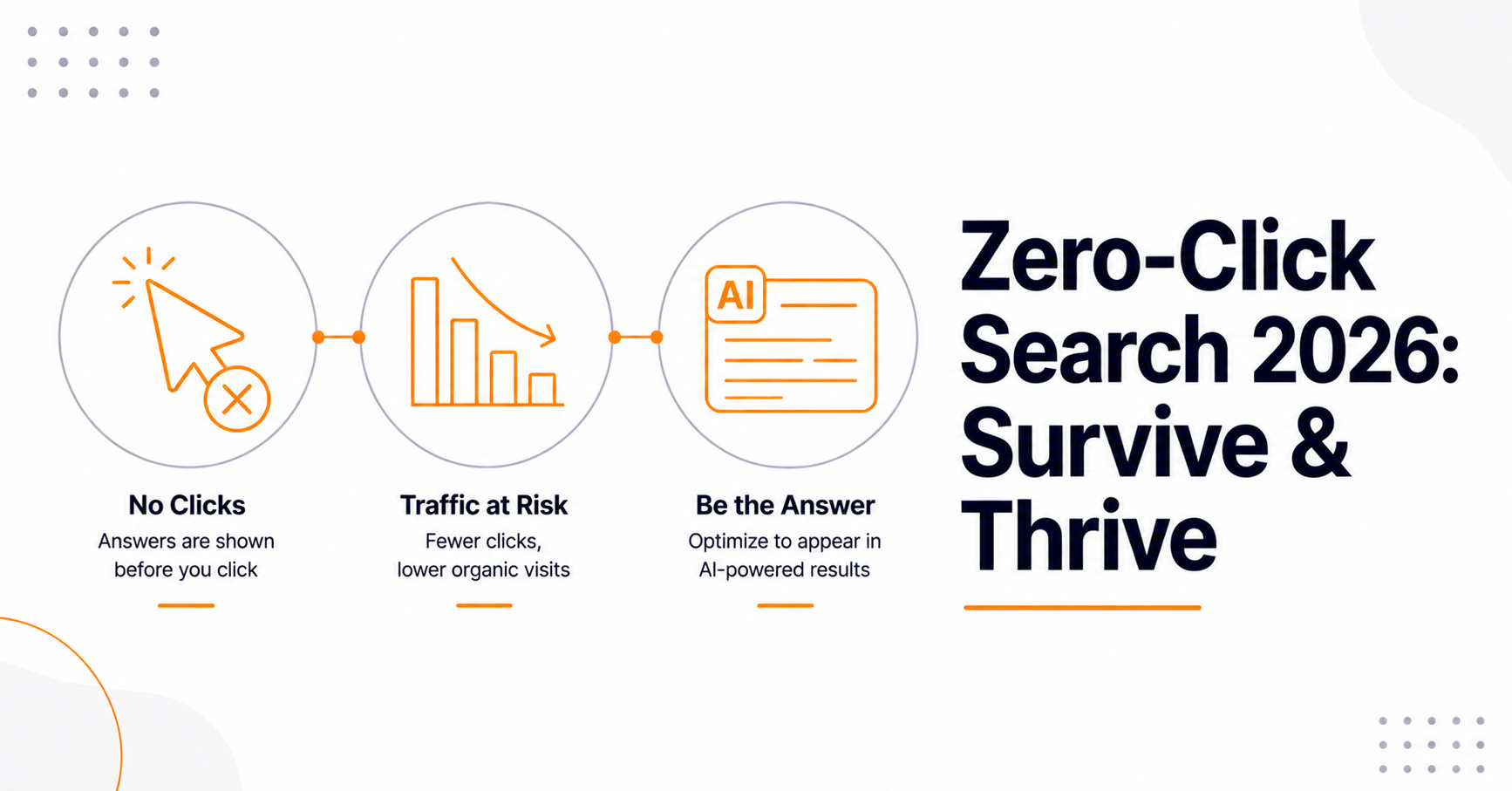
Zero-Click Search 2026: A Survival Guide

Zero-Click Search in 2026: How to Survive (and Thrive) When Google Stops Sending Traffic
Here is the uncomfortable truth that most SEO guides are still tiptoeing around: Google has been systematically reducing the traffic it sends to external websites — and in 2026, that process has reached a tipping point.
Over 60% of all Google searches now end in a zero-click event. The user types a question, receives an AI-generated answer directly on the results page, and leaves without clicking a single link. No sessions in your analytics. No ad impressions. No conversions. Just… gone.
For website owners, marketers, and SEO professionals who have spent years building traffic through organic search, this feels like the rug is being pulled out. But here's the equally important truth: zero-click search is survivable — and for well-prepared brands, it is actually an opportunity. This guide explains exactly how.
Understanding Zero-Click Search: A Brief History
Zero-click searches are not new. Google introduced Featured Snippets in 2014, Knowledge Panels around the same time, and People Also Ask boxes in 2015. Each of these features was designed to answer questions directly on the results page — reducing the need to visit an external site.
For years, SEOs debated whether these features helped or hurt traffic. The consensus was mixed: Featured Snippets sometimes increased clicks (through awareness and authority signalling) while other times they resolved the query entirely.
Then came 2024, and Google launched AI Overviews at scale. The impact was immediate and measurable. Zero-click rates on news searches jumped from 56% to 69% in a single year. By 2025, roughly six in ten searches across all categories ended without a click. By mid-2026, that figure had risen further.
SparkToro's research puts the current figure at less than one-third of all Google searches still generating a click to an external website. The rest are satisfied on the results page itself — by AI Overviews, Knowledge Panels, map packs, shopping results, and direct answer boxes.
Which Types of Content Are Most Affected?
Not all content is equally exposed to zero-click erosion. Understanding which categories are most at risk helps you prioritise your adaptation strategy.
Highest Risk: Informational Queries
Queries like "what is the capital of France," "how many ounces in a pound," "who won the 2022 World Cup," or "what is SEO" are almost always resolved directly on the results page. These were already heading toward zero-click dominance before AI Overviews; now they are near-completely captured. If your site's traffic depends heavily on informational queries with simple answers, you are facing the steepest decline.
Check which of your pages target high-volume informational keywords using our Meta Tag Analyzer — it gives you a fast read of how pages are framed and indexed, helping you spot which ones are most exposed to AI answer replacement.
High Risk: Definition and "What Is" Content
Pages built around defining terms, explaining concepts, or answering "what is X" questions are prime candidates for AI Overview absorption. Google's language models are trained precisely on this type of content, and they reproduce it confidently in answer summaries.
Medium Risk: Comparison and "Best Of" Content
Listicles, product comparisons, and "best X for Y" content are partially captured by AI. Google will often generate an AI Overview with a short list, then link to more detailed comparisons below. The risk here is real but not total — nuanced comparisons and original rankings still attract clicks.
Lower Risk: Transactional, Navigational, and Local Content
Users searching for a specific product to buy, a brand's website, or a local business are still largely clicking through. Transactional intent — where the user wants to do something, not just know something — is harder for AI to fully satisfy on the results page. Local search results (maps, reviews, opening hours) are partially captured but still drive significant foot traffic and calls.
Lowest Risk: Unique, Original, and Deep Expertise Content
Long-form investigative journalism, original research with proprietary data, tools and calculators, interactive content, and deep technical guides that require expertise to follow — these are the hardest content types for AI to replace. Users who encounter them still need to visit the actual page. They represent your safest long-term content investments.
The Bright Side of Zero-Click: AI Citation Converts Remarkably Well
Before we get to the survival strategies, it is essential to reframe the narrative. Zero-click is not purely a loss. Research from Ahrefs found that traffic from AI citation tools is tiny in volume but extraordinary in quality:
- AI referrals from ChatGPT convert at around 15.9%
- AI referrals from Perplexity convert at around 10.5%
- AI referrals from Claude convert at around 5%
- Typical organic search conversions average around 1.76%
In one case study, AI search drove just 0.5% of all visitors but accounted for 12.1% of signups — a 24-to-1 conversion advantage over organic traffic. When an AI cites your brand, it is effectively a warm endorsement. The user arrives pre-sold.
This means the goal in 2026 is not just to fight for clicks — it is to engineer AI citations that bring in smaller but far more valuable audiences.
8 Strategies to Thrive in a Zero-Click World
Strategy 1: Optimise for AI Citation (GEO)
If you cannot stop AI from answering the query, make sure it is your answer the AI uses. Generative Engine Optimization (GEO) is the discipline of structuring content so that AI systems preferentially cite your pages as a source. Key tactics include leading with direct answers, using FAQ schema markup, structuring content in extractable short paragraphs, and backing every claim with sourced data.
Even in a zero-click result, appearing as the cited source in an AI Overview builds brand awareness, signals authority, and — critically — drives the high-converting traffic described above when users do decide to click through.
Validate your schema markup using our JSON Formatter to ensure clean, error-free structured data that AI crawlers can reliably parse.
Strategy 2: Double Down on Tools, Calculators, and Interactive Content
AI cannot replicate interactive functionality. A calculator that converts kilograms to pounds, a tool that grades on-page SEO, a generator that produces meta descriptions — these require a visit. They create genuine, irreplaceable utility that no AI summary can provide in the results page.
Tools and calculators also build returning users. Someone who finds value in a free online tool bookmarks it and comes back — creating traffic that is independent of search engines entirely. This is exactly the model that underpins NasSeoTools.com, where every free SEO and utility tool creates a direct, search-independent relationship with its users.
Tools like our Word Counter and Website SEO Score Checker are examples of content that zero-click search simply cannot replace.
Strategy 3: Build Branded Search Volume
When more people search specifically for your brand name — rather than a generic query — you are no longer competing in the zero-click pool. Branded searches are navigational in intent; the user knows where they want to go. These almost always generate a click.
Branded search volume grows through content marketing that gets noticed, social presence, digital PR, podcast appearances, community participation, and — increasingly — AI citations. Every time an AI tool mentions your brand as a recommended resource, it seeds branded search volume as users look you up afterward.
Strategy 4: Create Original Data and Research
AI systems cannot cite data that does not exist yet. When you conduct original surveys, analyse proprietary datasets, or publish exclusive research, you create content that AI systems will specifically reach for when answering questions in your niche — because yours is the only source for that information.
Original data also attracts backlinks naturally, which in turn strengthens both traditional SEO rankings and GEO citation authority. It is one of the highest-ROI content investments available in 2026.
Strategy 5: Shift Focus from Traffic Volume to Traffic Quality
The era of obsessing over raw traffic numbers is ending. A site receiving 10,000 highly qualified visitors per month from AI citations, direct search, and community referrals will outperform a site receiving 100,000 low-intent clicks from informational queries that never convert.
Reframe your reporting around engagement rate, conversion rate, revenue per visitor, and return visitor rate — metrics that reveal the actual value your traffic generates. Use our Domain Authority Checker to benchmark your overall authority signals and prioritise quality-building activities over volume chasing.
Strategy 6: Diversify Your Traffic Sources
Any single traffic source is a liability. The brands most damaged by zero-click search were those that had built 80%+ of their traffic on informational organic search — a single-channel bet that the algorithm rewarded for years before pulling the rug.
Invest in building diversified traffic: email newsletters (owned audience, algorithm-independent), YouTube SEO (a separate search ecosystem), social media community building, Reddit and niche forum participation (increasingly surfaced in Google results), podcast guest appearances, and direct partnerships with other site owners.
Strategy 7: Update Content Aggressively and Consistently
AI systems, especially those using live web retrieval, heavily favour fresh content. Research points to a "3-month citation cliff" — content that has not been meaningfully updated in over 90 days sees a sharp decline in AI citation frequency.
Build a systematic content refresh cadence. Audit your top-performing pages every 60–90 days, update statistics with current figures, revise examples, refresh internal links, and ensure FAQs reflect questions people are actually asking right now. Use our Meta Tag Analyzer to quickly audit whether your metadata still accurately reflects refreshed content.
Strategy 8: Embrace the Niche, Resist the Generic
In a world where AI can generate a generic answer to any generic question, the premium is on specificity. Highly specific content — targeting narrow audiences, answering niche questions, covering topics with genuine depth — performs better in AI citations and attracts more committed audiences.
"Best project management software" is a battlefield where AI generates the answer. "Best project management software for remote construction teams managing subcontractors" is a query that still rewards the specific, expert source. Go narrow. Go deep. Build the kind of resource that the AI references rather than replaces.
How to Measure Your Zero-Click Exposure
Before you can adapt, you need to know where you stand. Here is a simple audit framework:
- Go to Google Search Console → Performance → Search Results. Filter by query type and identify your top 20 traffic-driving keywords.
- Search each keyword manually on Google. Note whether an AI Overview, Featured Snippet, or Knowledge Panel appears. If yes, your page is zero-click-exposed.
- Check click-through rate trends for these queries in Search Console. Declining CTR with stable impressions is the clearest signal of zero-click erosion.
- Categorise your content by the risk tiers outlined above (informational, definition, comparison, transactional, original/interactive).
- Prioritise your adaptation strategy based on which high-traffic, high-value pages face the most zero-click exposure.
The Bigger Picture: Search Is Evolving, Not Dying
It would be a mistake to interpret zero-click search as the death of the web or the end of SEO. Billions of searches happen every day. Even at 60% zero-click, the remaining 40% still represents an enormous volume of clicks to external sites. The pie is not shrinking into nothing — it is being sliced differently.
The brands that thrive in 2026 and beyond will be those that understand the new rules: build tools and interactive content that AI cannot replace, earn citations that bring high-converting visitors, cultivate owned audiences that are not at the mercy of algorithmic shifts, and create the kind of specific, deep, trustworthy expertise that AI systems want to cite rather than compete with.
Zero-click is not the end of your website's value. It is a signal to build something more valuable.
Frequently Asked Questions: Zero-Click Search
What is zero-click search?
A zero-click search is a Google search where the user gets their answer directly on the results page — through an AI Overview, Featured Snippet, Knowledge Panel, or other on-page element — without clicking through to any external website.
How many searches are zero-click in 2026?
Current research indicates that over 60% of all Google searches in 2026 end without a click to an external website. SparkToro's data suggests fewer than one-third of searches now generate an external click.
What types of queries are most affected by zero-click?
Informational queries (definitions, facts, how-to questions with simple answers), weather queries, conversion queries (currency, unit conversions), and sports scores are most affected. Transactional, local, and highly specific niche queries are least affected.
Can zero-click actually help my brand?
Yes — if your content is the source cited in the AI answer. Being cited in an AI Overview or AI chatbot response builds brand authority, increases branded search volume, and drives high-converting clicks from users who arrive pre-qualified by the AI's recommendation.
How do I protect my site from zero-click search?
Diversify your traffic sources, invest in interactive tools and calculators that require a site visit, build your email list for an owned audience, create original research that AI must cite, and optimise for GEO so your brand is the one referenced inside AI answers.